Warning (PG16)
This episode contains adult themes. Reader discretion recommended.
The alarm on his cheap data slate screamed at 2:47 PM, an obscene hour to wake, but night shift life had its own rules. Jin slapped it silent and lay still, letting the familiar trilogy of sensations announce themselves: arid mouth like sandpaper, temple throbbing in rhythm with his pulse, the faint chemical aftertaste of too much caña coating his tongue.
The shower was always too cold. The building’s water heater had died three months ago, and the landlord, a scarecrow of a man named Señor Echevarria, had no intention of fixing it. Jin stood under the thin spray and let it punish him, watching his borrowed face in the grimy mirror.
The biological alterations Karasu’s people had paid for, subtle shifts to bone structure, eye shape, the angle of his jaw. It was the face of Tao Lim, a composite sketch of a man who’d never existed. Like since the first time he’d seen the results, he avoided his own eyes.
You choose this, he told himself. This is survival, this is freedom. The lie sat in his stomach alongside the regret. On his crumbling concrete balcony, he smoked half a cigarette and drank instant coffee so weak it barely qualified as either.
Below, Montevideo stirred, traffic crawling along the Rambla, tourists wandering toward the waterfront, the city a perpetual hum of commerce and desperation. Jin watched it all without seeing it, running through the mental checklist of tasks that passed for purpose: errands, deliveries, high-roller escort at six. He stubbed out the cigarette, drained the coffee, and became Tao Lim for another day.
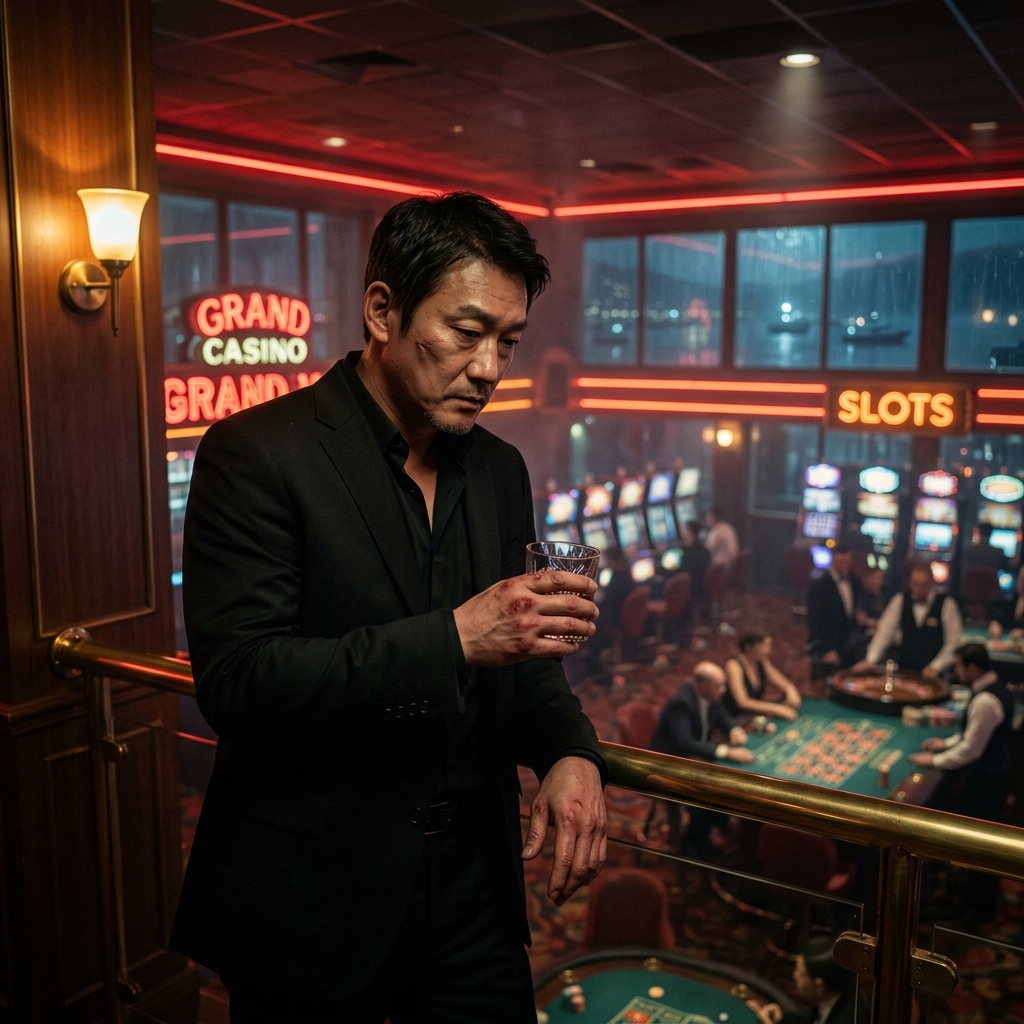
La Sirena Roja perched above the waterfront like a patient predator, its neon sign casting pulsing red light across the street: a heartbeat, a warning, an invitation. The casino occupied three floors of a renovated warehouse, its interior all polished brass and threadbare carpets, chandeliers that hadn’t been cleaned in years and slot machines that definitely hadn’t. Jin had worked here for eight months by now, long enough to know every exit, every camera blind spot, every regular’s tells at the tables.
He arrived early enough to check in with Marcelo, the floor manager, a squat Argentine with a comb-over and the patience of a man who’d seen everything fall apart twice. Marcelo’s office smelled of stale coffee and cheaper cologne. “El Boxeador”, Marcelo didn’t look up from his screens, “High-roller at six. Brazilian, construction money, likes to flash. Keep him happy until he loses it all, then keep him alive after. His wife’s brother is someone important in São Paulo.”
“They’re all someone important to someone somewhere”, Jin commented dryly. “Not all of them have brothers-in-laws who’ll send men”, Marcelo finally looked up, eyes flat, “This one will. So don’t let him get stabbed in my bathroom.” Jin nodded, “The usual.” Marcelo almost smiled, “The usual.”
The Brazilian, last name: Silva, first name: something with too many syllables, was exactly as advertised. Gold rings on every finger, a watch worth more than Jin’s annual salary, cologne that arrived five minutes before he did. He played roulette with the confidence of a man who’d never truly lost, dropping thousand-Funding Units chips like they were pocket change, laughing too loud at his own jokes, slapping the backs of dealers who visibly flinched. Jin shadowed him from the VIP balcony, watching the room the way he’d once watched opponents in the ring, weighing angles, distances, threats.
The Brazilian was obnoxious, his money only almost worth it. Silva had moved to blackjack and unlike roulette it required actual thought. The Brazilian was drinking and he’d been drinking since six. His stack of chips had dwindled from impressive to merely respectable, and the set of his jaw had shifted from expansive to tight. The dealer, a young woman named Lucia with tired eyes and the patience of a saint, laid out the cards. Silva had sixteen. The dealer showed a ten. Every person at the table knew what Silva should do. He hit, drew a king, twenty-six, a bust.
Silva stared at the cards like they’d personally betrayed him. Then he stood up, chair scraping backward, and backhanded Lucia across the face. Jin was moving before she hit the ground. The Brazilian was big, six-three, maybe two-twenty, the kind of soft-strong that came from never actually fighting but always winning arguments through money and connections. He had his hand raised for a second swing when Jin’s forearm caught his throat from behind, locking against his windpipe, dragging him backward off balance.
“Señor Silva”, Jin’s voice was calm, casual, “Time to leave.” The Brazilian thrashed, clawing at Jin’s arm, but Jin had been boxing since he could walk. He knew how to control a man’s body, how to use leverage against mass, how to make size practically irrelevant.
He marched Silva through the casino floor past gaping tourists and dealers who’d seen this before, past the security desk where two younger men should have been helping but weren’t, through the employees-only door and into the alley. He released Silva into a stack of garbage bags. Behind Jin the dealer, Lucia came running with a bag full of Silva’s chips, her left cheek pink and swollen. The Brazilian came up swinging. Lucia dropped the bag at their feet and rushed back into the casino.
Jin slipped the first punch easily, a wild haymaker that announced itself from next Tuesday, and answered with a short jab to the solar plexus that folded Silva like cheap luggage. The Brazilian went down, gasping, and Jin stood over him, breathing evenly, knuckles singing with familiar pain.
“Take your chips,” Jin said coldly, “You can get them converted at eighty-three percent value, because you hit a dealer. Marcelo’s rule, not mine. If you want to argue about it, I’ll be inside.” He turned to go, then paused, “Your brother-in-law in São Paulo? He’d want you to know when to stop, save him the embarrassment.”
He left Silva in the alley, retching into the garbage. Back inside, Lucia had been replaced at the blackjack table by a kid who looked even more exhausted. She sat in the break room with an ice pack against her cheek, crying silently. Jin stood in the doorway, knuckles already bruising, watching her not watch him.
“I’m sorry,” he said. She looked up, surprised, “What for? You did your job.” A long pause, “For not getting there faster.” Then Lucia laughed, a wet, broken sound, “You’re the only one who apologizes for anything in this place. Ever.” She shook her head, “You know how many times I’ve been hit? By players, by managers, by my ex-husband? First apology I’ve heard in years.”
Jin had nothing to say to that. He stood there for another moment, then nodded and left. In the bathroom, he checked his jaw in the mirror. A bruise was forming along the bone, not from Silva’s punch, which had missed entirely, but from the angle of the takedown, his own face bouncing off Silva’s shoulder. It would swell, it would color, it would match the ones on his knuckles. Tao Lim’s face paid the price, he thought.
The rest of the shift passed in the usual blur. Surveillance reports, a drunk who’d pissed in the corner of a slot machine row, two tourists arguing over chips in a way that might become violent but didn’t. The Brazilian never returned, which meant either he’d taken the eighty-three percent or Marcelo’s men had helped him understand the alternative. When Jin’s shift ended, he sat down at a low-stakes poker table in the back corner, where the lights were dimmer and the dealers knew not to make conversation.
He played for two hours. Won some, lost more. The cards became shapes, the chips became numbers, the world narrowed to probability and impulse, the only two things that made sense to him now. When he finally stood up, he was down seven hundred Funding Units, not catastrophic, but enough to feel. Enough to hear Seraphina’s voice in his head, clear as the day she’d died: Jin, you’re a dreamer who thinks luck is the same as faith. He’d never understood what she meant. He still didn’t.
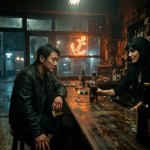
La Bodega de los Olvidados was nearly empty, it was the kind of hour that belonged only to drifters and night shift workers who hadn’t figured out how to go home. Diego was behind the bar, as he always was, wiping a glass that would never be clean enough. “Tres Tercios?” he asked. Jin shook his head, “Caña. Straight.” Diego’s eyebrow rose, but he poured. A full glass of the cheap sugarcane rum, amber and aggressive. Jin took it to his corner, the one with the view of nothing, and slumped over his drink immediately.
The first sip burned, the second burned less. By the third, the world had softened at the edges, the way it always did when he stopped trying to hold it together. He thought about Seraphina’s hand on his cheek, a week before she died. They’d been in their bed, Rei asleep in the other room, and she’d cupped his face like he was someone irreplaceable. “Promise me honey”, she’d said, “Promise me you won’t gamble anymore. We can’t afford it, we have nowhere else to run.”
He’d promised, he’d meant it and then he’d made the debt anyway; the one she’d tried to protect them from, the one that led her to confront men who didn’t negotiate, who didn’t accept apologies and who didn’t leave witnesses. She died because of me, because she loved me, because I wasn’t strong enough to be loved. He drank. The rum didn’t argue. At closing time Diego slid a napkin across the bar. Jin read it without moving.
El boxeador siempre esquiva el golpe que ve venir. Pero el amor siempre golpea por la espalda.
The boxer always dodges the punch he sees coming. But love always hits from behind.
Jin folded it carefully, precisely and added it to the collection in his pocket. The napkins were multiplying, a paper trail of a man coming apart in slow motion. He’d counted them last week. Forty-seven. Now there were more. He drank until the bar was clean, chairs on tables and leaving was inevitable, then walked home through streets that were already filling with daytime people, people who had jobs and families and reasons to be awake.
Jin was a shadow moving through their world, invisible, unreal, the memory of a man wearing a stranger’s face. In his apartment, he didn’t bother with the too-cold shower. He lay on the bed fully clothed, staring at the water-stained ceiling, and let the memories come. Rei asleep in his lap when she was small, her ruby hair spreading across his thighs like fire, her breath slow and trusting. The weight of her, the warmth, the way she’d murmured ‘papa’ in her sleep. He’d sat there for hours, afraid to move, afraid to wake her, afraid to break the perfect stillness of being needed.
Now she was out there somewhere, moving through a world he’d deserted her to. She probably never missed him at all. The tears came without warning, as they usually did; silent, hot, useless. He didn’t wipe them away. There was no one to see, no one to pretend for. Rei. He shaped the name with his lips but no sound. Rei, Rei, Reina. The ceiling didn’t answer. It never did.
He woke at 2:47 PM, exactly twenty-four hours after the last time. Arid mouth, throbbing temple, the taste of stale caña and mourning. The bruise on his jaw had flowered overnight, deep purple shading into black, a map of the previous night’s work.
In the bathroom, he avoided his own eyes again. But he caught a glimpse of the bruise, the shape of it, and for just a moment he saw the old Jin, the boxer, the fool, the man Seraphina had loved. Then the face shifted, became Tao Lim again, and the moment passed. He stood under the too-cold water and let it punish him. On the balcony, half a cigarette and watered down instant coffee.
Below, Montevideo stirred. In his pocket, forty-eight napkins pressed against his heart. Another day, another shift, another night of forgetting that never quite took. Jin smoked and watched the city, waiting to become someone else again.
Still, never even in his drunkest moments, did he speak of Rei and he never mentioned Karasu Komorebi. Jin swallowed anything still alive. But sometimes, on the roughest nights, when the loneliness settled deep and the ghosts crowded too close, he whispered Seraphina’s name. Softly, like a prayer, like an apology. On one such night, after too much rum and not enough luck, someone finally heard him and listened.


Leave a comment