Warning (PG16)
This episode contains adult themes. Reader discretion recommended.
Montevideo
South America didn’t welcome Jin Morita so much as it swallowed him, the same way the sea swallowed the sound of the docks each night. He arrived under a different name: Tao Lim, with a new face and papers provided by Karasu Komorebi’s associates. Mirage City was half a world away, and Jin let it be. It had taken everything from him, Seraphina’s life, his pride, his daughter and still he felt its breath on the back of his neck.
He settled in Montevideo, a coastal city that smelled of diesel, salt and cheap sugar-cane based rum known as caña. It was a place where men disappeared between the slats of neon-lit casinos and nobody asked questions unless they were paid to. The first few months were a blur of odd jobs: bouncing for a nightclub with a sticky floor, running security for a shipping yard, escorting drunken tourists back to their hotels. Anything that paid enough for rent and drinks.
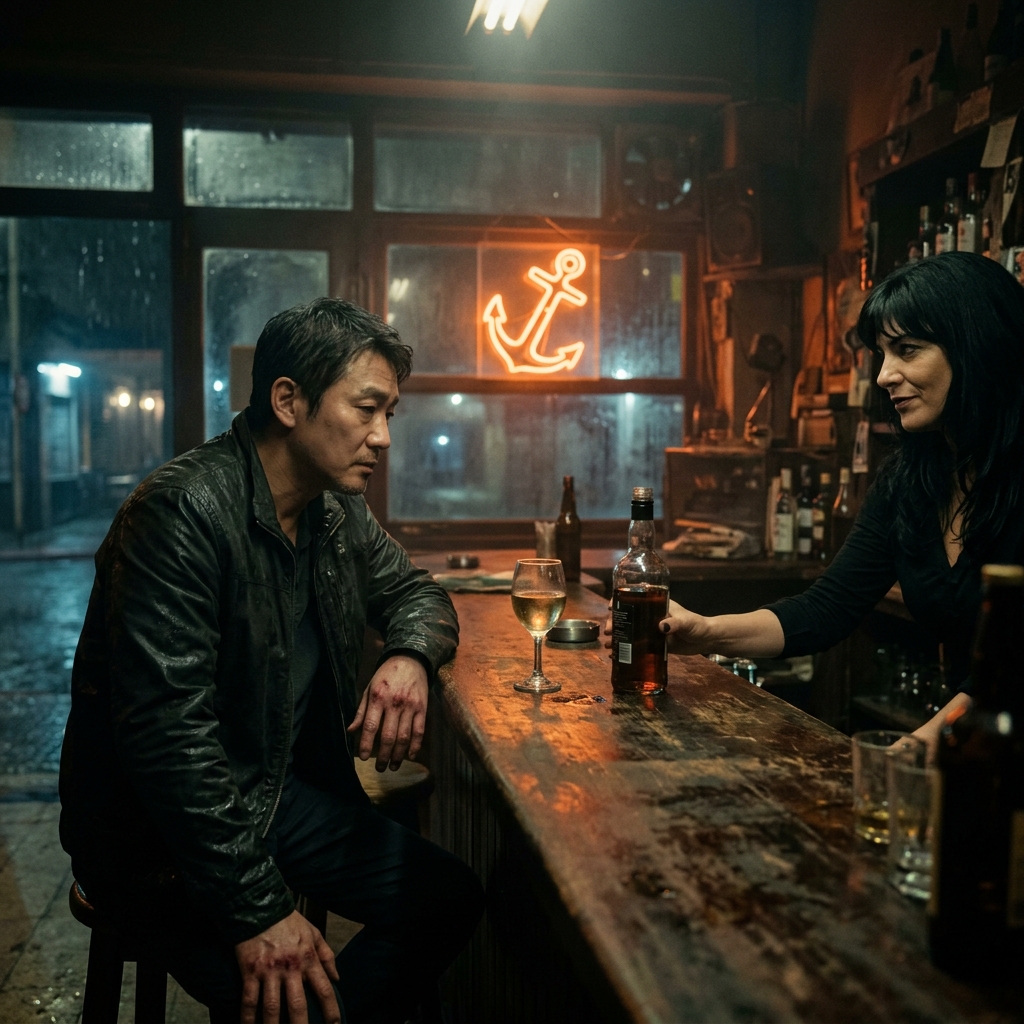
The rain in his new home didn’t fall so much as float from the sky, thick and humid, clinging to Jin’s shirt like a ghost of the past he couldn’t shake. He’d been here three months, maybe four, time blurred when you stopped counting days and started counting drinks. His new name, Tao Lim, felt like a borrowed coat, always slightly too tight across the shoulders. But the barstool at La Cueva del Marinero fit like a glove.
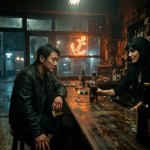
The bar was tucked between a pawnshop and a shuttered tattoo parlor in the old port district, its sign flickering intermittently: a rusted anchor half-submerged in neon orange. Inside, the air smelled of damp wood, fried fish, and the faint, sweet burn of caña. The bartender, a woman named Rosa-Maria with black hair and a voice like gravel, didn’t ask questions. She just poured. Jin had stumbled into La Cueva drunk his first week, half-collapsed after a shift at the shipping yard that had left his knuckles raw, his back screaming and smelling of salted fish.
He’d ordered a Medio y Medio, the local staple: half dry white wine, half sparkling. Rosa-Maria had slid it across the bar with a nod. “First shift?” she’d asked. “First time a fish caught me, damn leaky crates,” he’d muttered, staring at the glass like it was responsible. She’d smirked, “You’ll learn.” He downed his drink. It was sweet, light, almost deceptively so; the kind of quench that made you forget you were drinking at all.
He ordered another, then another. By the third, he watched another customer order a Medio y Medio with a shot of rum added. On impulse he asked for a splash of caña too. Why not make it heavier, make it honest? Rosa-Maria’s eyebrow climbed when he asked for even more rum, “You want to mix it in equal measures now?”
“Damn right!”, the words came out before he’d thought them through, “One third wine, one third bubbles, one third rum: tercio y tercio y tercio!” She stared at him for a long moment, then shrugged, “Too long. Tres Tercios is better.” He’d laughed, the first real laugh since arriving in Montevideo. The sound surprised him, rough and unfamiliar in his own throat, “Tres Tercios. I like that.” She poured it, three equal measures in a glass that suddenly looked like a confession. Jin raised it to her in a wordless toast. Rosa-Maria didn’t smile, but something in her eyes softened, “You’ll fit in here, Tao.”
It became his ritual. Every night after his shifts, after the silence of his tiny apartment with its water-stained ceiling and the mattress that remembered every body that had ever slept on it, he’d return to La Cueva. Rosa-Maria would have the drink ready by the time he settled at the bar. The glass cold, the rum just enough to bite, the wine just enough to soothe.
He’d move to a seat by the window, watching the port lights flicker across the water like dying stars, and imagine Seraphina cooking in their old Mirage basement apartment kitchen, the scent of basil and citrus in the air, her hands dusted with flour, her laugh warming spaces the city’s endless rain could never reach. When the memories became too vivid, he’d whisper her name into the glass. Then drink it down. Sera, swallow, Sera, swallow, Sera, empty. The glass never talked back.
Montevideo was a city of bars without questions the way Mirage was a city of neon and lies. Each district had its own, each with a personality as distinct as the men who disappeared into them. Jin mapped the local bars slowly, deliberately, the way he’d once mapped opponents in the ring: looking for weaknesses, angles, the places where a man could let his guard down without getting killed.
El Barco Hundido came second to La Cueva. A converted fishing boat permanently moored in the old harbor, its decks warped by decades of weather and footsteps. The owner, a retired sailor named Mateo, had a scar running from ear to chin and a laugh like a foghorn cutting through mist.
Jin would sit on the deck, salt spray stinging his face, and order his Tres Tercios while Mateo told stories of storms off the Cape of Good Hope and smugglers who’d paid in gold doubloons that turned out to be lead.
“Tao, you drink like a man trying to forget,” Mateo said once, five drinks into an evening when the sea was calm and Jin’s knuckles were still raw from a shipping yard dispute. He didn’t deny it, just raised his glass. “Try drinking like you’re remembering,” Mateo added after a long pause, “Might as well make peace with what stays.”
Jin thought about that for the rest of the night. He was still thinking about it when he stumbled home at 3 AM, when he woke with the taste of caña coating his tongue like regret and when he sat on the edge of his bed and stared at a wall that had never once seen Seraphina’s shadow. Make peace? As if peace were something you could order from a bartender.
La Bodega de los Olvidados became his third boozy shelter. A dive in the heart of the Ciudad Vieja, where the walls were lined with faded posters of revolutionaries and forgotten football stars, their faces bleached by time and cheap lighting. The bartender, a wiry man named Diego with ink-stained fingers and eyes too old for his face, had a habit of scribbling poetry on napkins between drinks. Jin would sit in the corner farthest from the door sipping his Tres Tercios, listening to Diego’s verses about lost loves and broken promises.
The regulars called him El Poeta and mostly left him alone. Sometimes they’d request poems for dead wives or absent children. Diego would write, and they’d pay in drinks, and everyone pretended the napkins weren’t really confessions. One night, after Jin had been coming for two weeks straight, Diego slid a napkin across the bar without preamble. Three lines in cramped, elegant script:
Tres Tercios, tres dolores:
uno por el pasado, uno por el presente, uno por el futuro que no llega.
Bebe, Tao. Bebe como si el mundo te lo debiera.
Three thirds, three sorrows: one for the past, one for the present, one for the future that never comes. Drink, Tao. Drink as if the world owes you.
Jin read it three times. Then he folded it carefully, precisely, the way Seraphina had taught him to fold pasta dough and tucked it into the pocket closest to his heart. Diego didn’t comment, already pouring another Tres Tercios.
Jin fell into deep contemplation about his dead wife, about his daughter whom he sold to pay debts he’d accrued with his fists and foolishness; his past rising like a tide no wall could hold back. “The world owes me”, he mumbled in a drunken slur at closing time, “and owns me.” Diego nodded like this made perfect sense.
Jin built his life in the spaces between those three bars, the way some men build families or fortunes. La Cueva for the nights when he needed silence and Rosa-Maria’s wordless understanding. El Barco Hundido for the evenings when Mateo’s stories could drown out his own. La Bodega for the moments when Diego’s napkin-poems gave shape to feelings he couldn’t name. The Tres Tercios became his signature without him meaning it to.
At La Cueva, Rosa-Maria had started keeping a bottle of caña specifically for him, tucked beneath the counter with a piece of masking tape labeled Mr. Lim. At El Barco Hundido, Mateo had added it to the chalkboard menu as El Chino, because no one could remember new cocktails and tourists liked stories. At La Bodega, Diego had written a poem about the drink that someone had used to wipe spilled wine, then framed and mounted the red stained napkin with blurred ink.
Jin read it every time he came in. Sometimes, when the rum hit just right, when the wine softened the edges and the bubbles lifted the weight just enough, he’d close his eyes and see Rei. Not the woman she must be now, moving through a world he’d abandoned her to, but the girl she’d been. Six years old, with unruly ruby hair like a bird’s nest around her big black eyes, those eyes that had looked at him like he was something worth believing in.
He’d see her in their cramped Mirage apartment, the one with the leaky window and the landlord who never fixed anything. She’d be sitting cross-legged on the floor while Seraphina cooked, asking questions about everything: why the rain fell, where the neon went when the lights turned off, why Papa’s hands were always bruised. He’d scoop her up, ignoring the pain in his knuckles, and spin her until she shrieked with laughter and promise her things he could never deliver.
Simple lies like: ‘I’ll always protect you’ or ‘everything’s going to be fine’. The kind of empty promises a man tells when he can’t face the truth: that he’s a gambler, a man who loves his family so much he’d do anything for them except the one thing that might actually help: changing.
He’d swallow Rei’s name together with the drink. Sometimes, in the space between the second and third sip, he could almost hear her laugh, and that was worse than silence.


Leave a Reply