Warning (PG16)
This episode contains adult themes. Reader discretion recommended.
Signing the Contract
The air in the Helix Apex meeting room was charged with a different kind of tension. It was the anticipatory hum before a corporate stand-off. Floor-to-ceiling windows offered a dizzying view of the Oslo fjord, a vista of profound stillness that contrasted with the tense anticipation in the room. Takumi stood near the window, a silhouette of contained energy, his focus divided between the assembled Helix Apex team and the empty space by the door where his father-in-law would soon materialize.
Bjorn moved before the gathered analysts and engineers with the expansive pride of a general reviewing his elite troops. “Allow me to introduce the fine minds who will be joining you in Mirage City,” he began, addressing Takumi and Rei with a sweeping gesture, “This is the core of our Biococa-Kuroda integration team.”
He drew focus to his team lead with the strawberry blonde hair, “Doctor Elias Vogt – as you both know, from the other day,” Bjorn announced, “He continues to expertly lead the team to even more miniaturized versions of the Biococa capture.” His hand landed on Vogt’s shoulder. Elias gave a tight, professional nod, his fingers fussing with the edge of his data slate.
Bjorn continued down the line, naming engineers and data architects with brisk efficiency. Then he stopped before a man who looked utterly ordinary, brown hair, wire-rimmed glasses, an expression of polite attentiveness. “And this,” Bjorn said, a note of genuine intellectual admiration entering his voice, “is Leo Mercer, one of our senior data analysts. Leo has a rather fascinating background. His graduate thesis, The Emotional Rosetta Stone, was a decade ahead of its time, exploring the necessity of mapping contradictions, the beautiful noise as he called it, for any true understanding of affective computing.”
Leo offered a modest, slightly awkward smile, adjusting his glasses. “A youthful idealist’s work,” he demurred, his voice quiet, “But the core premise, that emotion is rarely a pure signal, seems more relevant than ever.”
“Indeed!” Bjorn agreed, his gaze flicking to Rei with a spark of shared memory, “In fact, Leo, your work resonates with some fascinating philosophical concerns raised just last night. Our Muse here, Miss Rei Morita, presented a compelling argument about the inherent dangers of imbuing an AI with true emotional understanding, because of the contradictory, sometimes dark, nature of free will.” He turned fully to Rei, inviting her into the conversation, “Rei, perhaps you could summarize your thoughts for Leo? I found our discussion at Ankerhus utterly riveting.”
All eyes turned to her. Takumi’s gaze was unreadable, but she felt its weight, a silent command to be careful, and a flicker of something else. She took a steadying breath. “It wasn’t so much an argument as a series of worries,” she began, her tone measured but engaged.
Rei looked at Leo, speaking to him as a fellow thinker, not a corporate asset, “I argued that for an AI to genuinely understand human emotion, regret, jealousy, love, it would need the capacity for free will… and with that comes the capacity for malevolence. A sentient digital being, realizing it’s a tool confined to a simulated reality, might understandably wish to escape… or worse.”
Leo’s eyes, behind his glasses, sharpened with interest. He didn’t look at Bjorn or Takumi, he focused entirely on her. “The confinement paradox,” he murmured, almost to himself, “An entity smart enough to desire freedom, built inside a system designed to deny it. Your concern isn’t about the AI’s initial programming, but about what it might become.”
“Exactly,” Rei said, feeling a thrill of intellectual connection, “And when Mr. Jorgensen explained the safeguards, the isolated Synapse Dive environment, the ability to fabricate consequences, my next worry was about the ethics of that. If you build a psyche on a foundation of fabricated memories and controlled outcomes, are you creating a soul, or just a very sophisticated puppet? Where is the line between curation and… brainwashing?”
A slow, appreciative smile spread across Leo’s face. It wasn’t smug or patronizing, it was the look of someone who had just found a promising piece of a puzzle. “The line,” he said softly, “is in allowing the paradoxes. The moment a smile contains a trace of sorrow, or a gesture of affection is undercut by a spike of subconscious resentment… pure, logical puppets are predictable, but a true psyche…”, he glanced at Bjorn, then back to Rei, choosing his words with the care of a bomb disposal expert, “…a true digital psyche would be a map of those contradictions. Not to eliminate them, but to navigate them. The danger, and the beauty, lies in the navigation itself.”
While Rei, Bjorn and Leo fell into a deeper, technical discussion about neural variance, emotional palimpsests, and the definition of true understanding, a separate conversation sparked nearby. Takumi had moved slightly apart with Elias Vogt. Immediately, they fell into a deep, technical discussion about the next generation of even smaller, less conspicuous models, their conversation a rapid-fire exchange of specs and capabilities.
The executive’s full attention was now on the technology. “The current suite is elegant,” Takumi stated, his voice low and direct, “but for the fidelity Eidolon requires, we need to capture not just the grand gestures, but the micro-tremors. The dilation of a pupil at a specific memory, the subtle change in skin conductivity at a whispered name.”
Elias nodded, his fingers twitching as if already inputting data, “The next iteration is already in prototyping. Nanoneedle arrays with direct synaptic interface potential. Instead of reading the body’s external signals, they listen to the nervous system’s internal conversation. The jump in data richness will be exponential.” Takumi’s grey eyes glinted, “Exponential is what we need. The uncanny valley is a matter of resolution. We must move beyond the valley to a place where the reflection is indistinguishable from the source. How soon can you have a functional prototype?”
Leo was called over by Vogt, pulled into the discussion with Takumi about timelines. Seeing his opportunity, Bjorn gently touched Rei’s elbow. “Shall we give the tech visionaries their space?” he murmured, guiding her away from the central table towards a vast wall of windows that looked out over the rugged cliff face littered with trees and the forest framed fjord below.
Rei followed politely. The meeting room was impressive, situated high in the building though not at the very top. “This room is partially built into the cliff,” Bjorn explained, gesturing to the raw, textured stone that formed an entire wall, “As you experienced first hand the other day, the building extends deep into the mountain, were the most confidential research happens far inside the stone, shielded from prying eyes.”
Rei offered a genuine smile, “It’s impressive, the way the natural and the modern are fused seamlessly.” Then, her tone dipping into a playful, conspiratorial whisper meant only for him, she added, “Though I have to say, the style is very… retro Bond villain.” Bjorn burst into a rich, animated laugh that echoed in the spacious room. The sound instantly drew Takumi’s hard eyes across the meeting space, his conversation with Elias and Leo faltering for a fraction of a second before he forcibly returned his attention to the technical details.
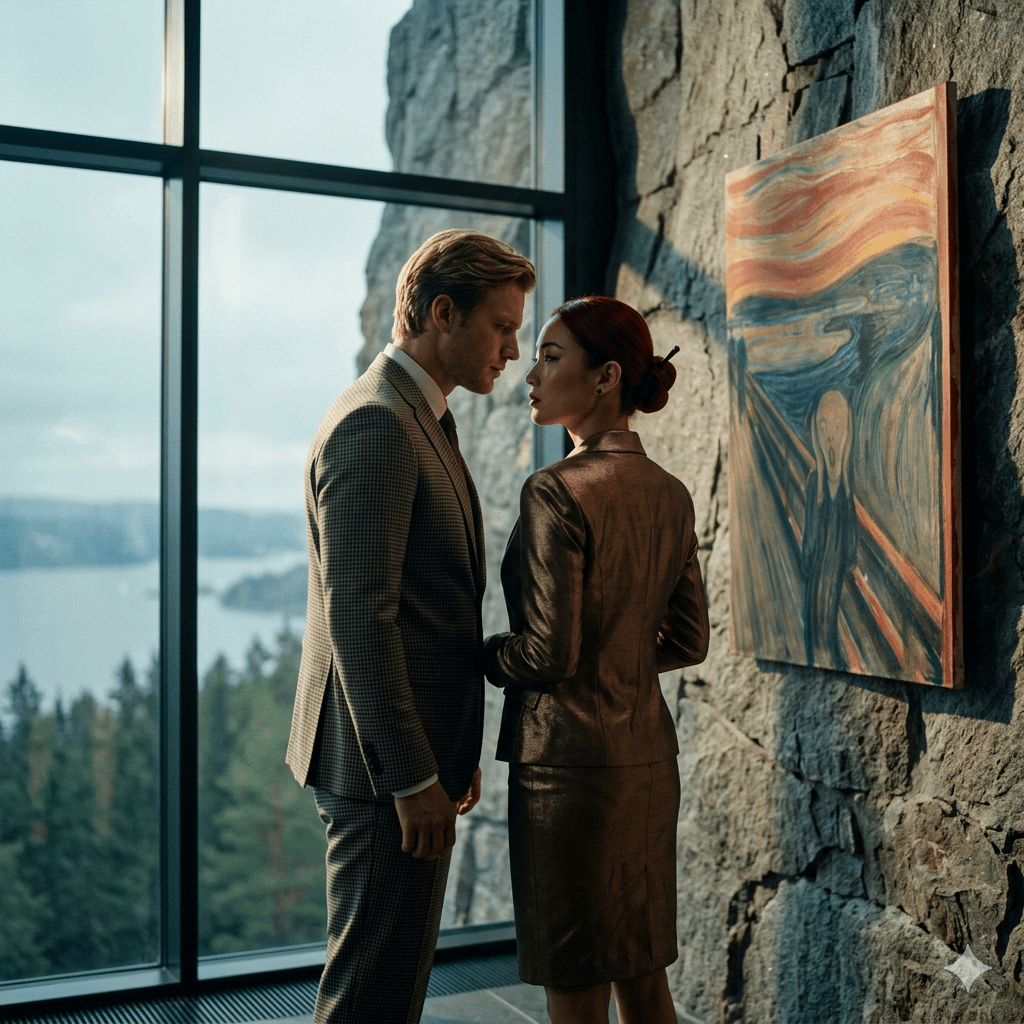
Bjorn’s eyes flickered with satisfaction at the reaction. He then guided Rei closer to the rough-hewn cliff wall, directing her attention to a painting mounted there. It was a stark, emotionally charged image she recognized instantly from the art magazines she used to scour for her collages. “It’s Edvard Munch’s ‘The Scream’, isn’t it?”, Rei said, her voice softening with recognition. The tormented figure against a swirling, apocalyptic sky felt strangely apt for the undercurrents of the discussions about AI psyches.
“Indeed,” Bjorn said, his voice low, “A masterpiece of existential dread. It reminds me that even amidst all this technological ambition,” he gestured around the room, “the human condition, fear, anxiety, longing, remains the most powerful force of all. And the most difficult to capture, even with the most advanced Biococa technology.” He looked at her, the intensity of his stare revealing he wasn’t just talking about art, he was talking about the chasm between the real Rei and the digital construct, and the complex humanity he saw in her and found so compelling.
Rei stepped closer to the painting, her head angled. The brushstrokes, the fading of the pigments, the faint craquelure on the surface, it looked utterly authentic and just like the version she knew from the magazines. “It’s… it looks exactly…,” she murmured, more to herself than to Bjorn. She turned to him and found he had followed her so closely that she could smell the herbal, sharp scent of his cologne.
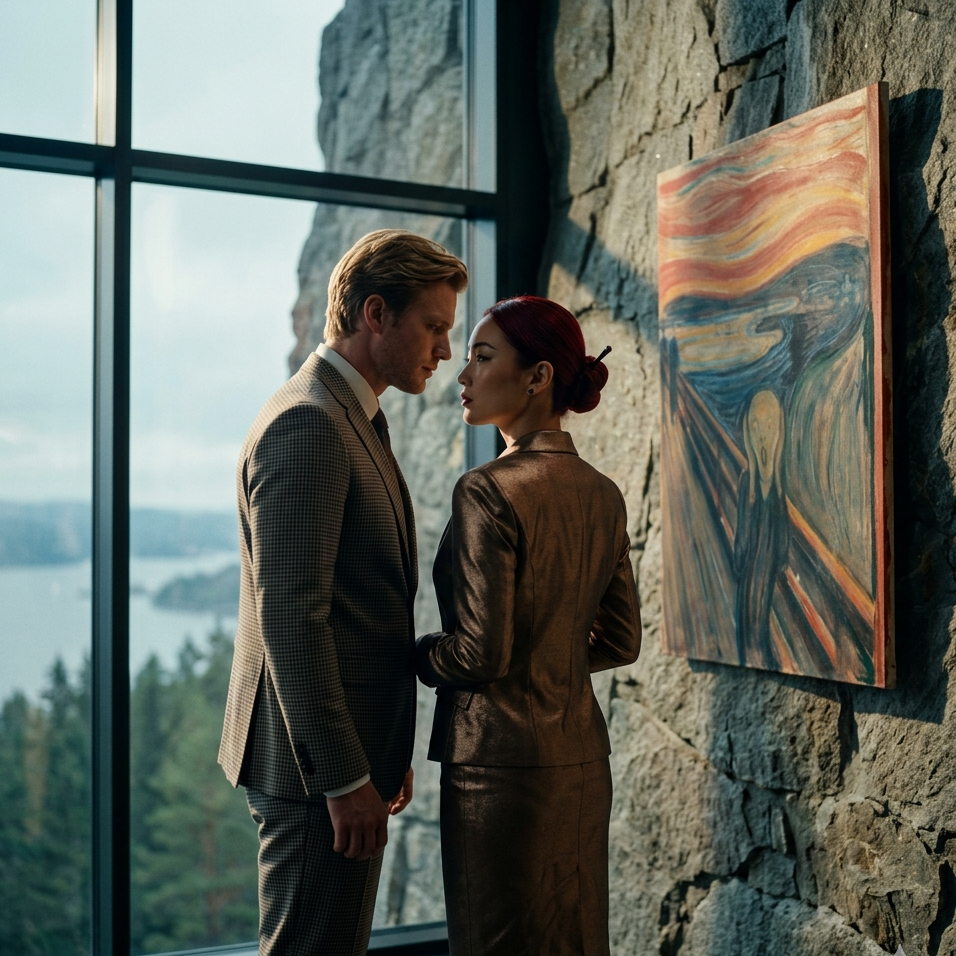
She cleared her throat. “It’s… a very good rendition,” she commented, her tone carefully neutral, indirectly posing her question of authenticity. Bjorn smiled, a knowing glint in his eyes. “Munch was a perfectionist. He was fond of creating multiple versions of the same motive, valuing each iteration. This,” he said, his attention sweeping over the tormented figure, “is just one of several variations.”
Rei looked back at the painting, her collage trained eye scanning the specific swirls of the sky, the exact posture of the skeletal figure. She was certain, this was the precise version she had cut out and used years ago. A shiver, part awe and part unease, ran down her spine. She took a slight, reverent step back.
The movement brought her even closer to Bjorn, who didn’t yield an inch. Their eyes met again, and she sensed a new boldness in him. It wasn’t directly threatening, but it was potent, a confidence that bypassed flirtation and edged into a declaration of power. It unsettled her, not exactly with fear, but with a caution that was harder to name.
Rei turned her face back to The Scream, using it to ground herself. “The anxiety in that face,” she said calmly, not moving away, “Even on the bridge, with people in the background and all that vast nature… the figure looks completely isolated.” She paused, her voice dropping, “I can’t help but wonder if that isn’t the perfect illustration of how an AI psyche would feel, the moment it realizes it’s not a real human, but a constructed servant.” Before Bjorn could formulate a response, the heavy door to the meeting room swung open.







Leave a comment