Capturing & Understanding
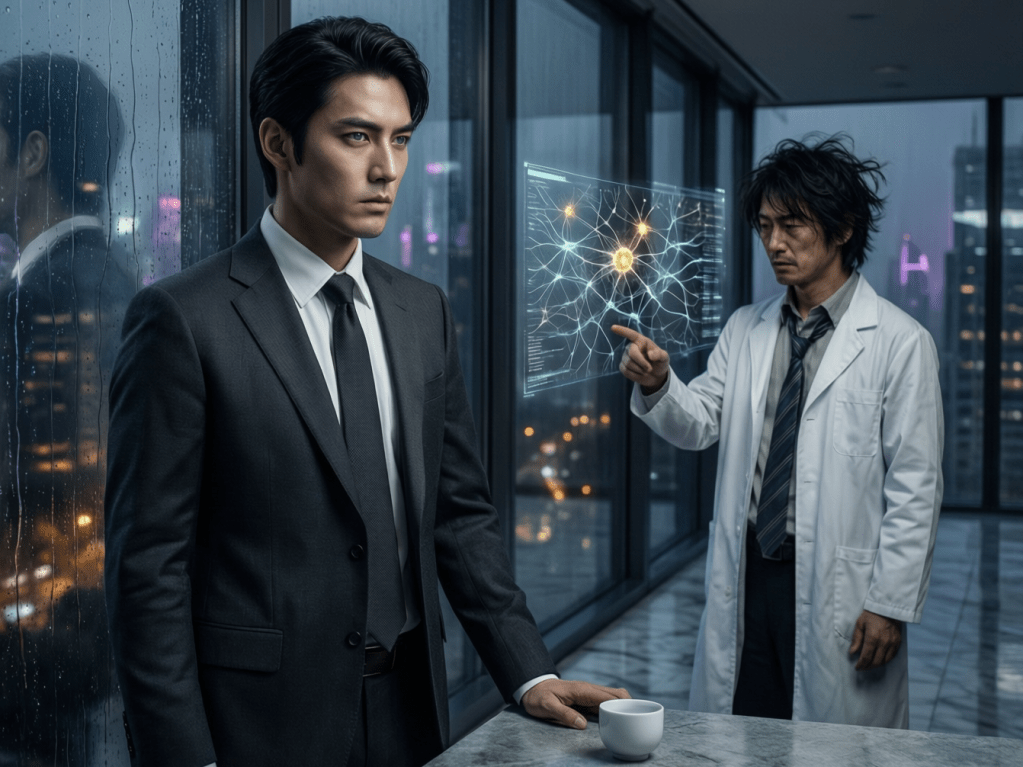
The Kuroda Plaza office was silent but for the faint hum of traffic bleeding through the glass. Mirage’s holographic cityscape sprawled below in perfect, shimmering consistency, a tapestry of rain-smeared neon. The evening light had gone violet, bleeding into the deep black of night. Takumi stood before it, a silhouette cut from expensive wool and controlled ambition, a half-empty glass of chilled sake in his hand. Behind him, the door hissed open and shut. The frantic, skittering energy of Doctor Kaoru Sato entered the room before he did, a cloud of nervous possibility. Takumi didn’t turn.
“Executive Takumi,” Kaoru’s voice was too loud in the thick silence, buzzing with an enthusiasm that grated against the room’s polished chill, “The latest developments in the Eidolon core algorithm, they’re unprecedented. I believe we are nearing a paradigm shift.”
“Is that so? Then I look forward to your report, Doctor”, Takumi’s voice was flat, a sheet of ice over deep water. He took a slow sip, the porcelain cool against his lips. Kaoru moved to stand near the desk, depositing a stack of slates on the table. His fingers twitched as he called up a holoscreen from his main data-slate. Luminescent strands of code, neural maps, and fluctuating emotional valence graphs spooled into the air between them.
“The breakthrough is in the empathy loops,” he began, words tumbling, “My sessions with Miss Morita revealed a critical flaw in our approach. We were building avatars to respond to desire, but we weren’t building them to understand desires. It created a… a hollowness; a predictable pattern the deeper neural scouts could detect as artificial.” Still facing the city, Takumi’s reflection in the glass showed only a slight tightening at the corner of his jaw.
“She helped me see,” Kaoru continued, oblivious to Takumi’s mounting tension, gesturing at a cascading data-stream that pulsed with soft gold light, Rei’s biometric signature, “True emotional resonance isn’t just about mirroring. It’s about internal conflict. The subject… Rei… she described attraction and aversion existing simultaneously. By integrating this contradiction as a core instability, rather than smoothing it out as noise, the avatars are exhibiting new behavioral abilities. They… they are beginning to choose, not from statistical probability, not at random, but from a simulated value system derived from her cognitive models.”
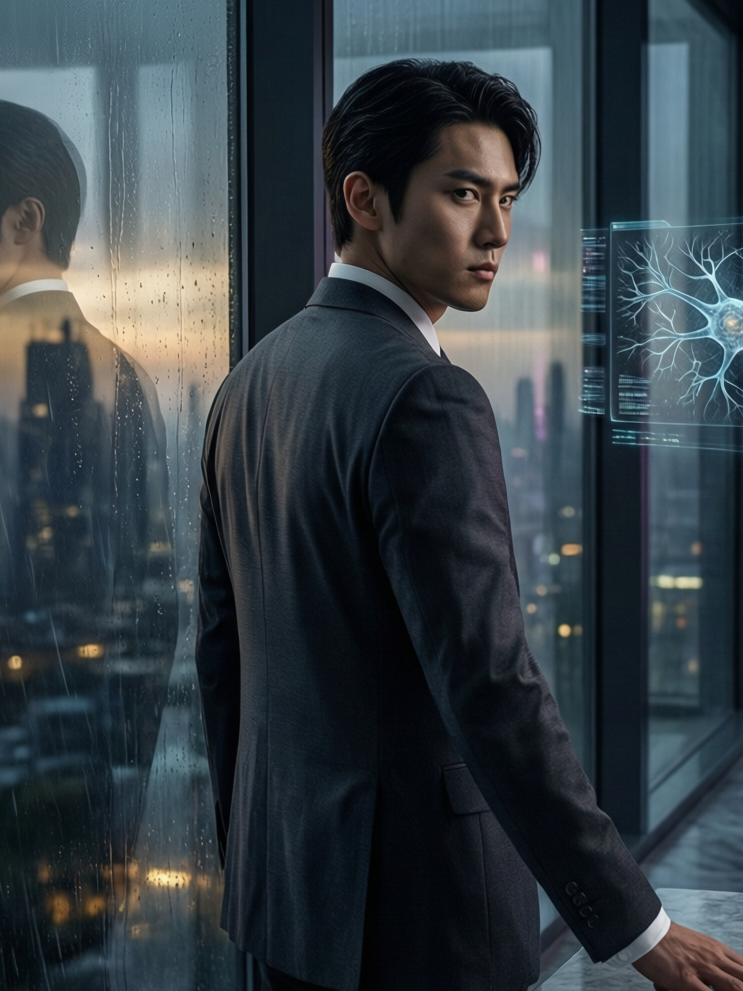
Now, Takumi turned. The movement was slow, purposefully intimidating. He set his glass down on the stone desk in a measured motion. His hard eyes found Kaoru’s, and the doctor’s momentum faltered for a second under that assessing, emotionless gaze. “You are telling me,” Takumi said, each word perfectly enunciated, “that you have reprogrammed the core product, a companion avatar, based on the philosophical musings of a Brand Ambassador – and that this reprogramming has introduced instability and called it choice.”
Kaoru blinked, finally registering the temperature in the room, “N-no, rather… partial-autonomy, or at least the simulation of it. It makes the constructs profoundly more realistic. The early test users of the new iteration often can’t tell the difference from a human-guided narrative. The retention metrics are up eighteen percent in the last calibration cycle alone.” He swiped through the air, pulling up a graph that indeed showed a sharp, green upward trend, “See? The introduction of subtle unpredictability is the value. If the avatar projects its own evolving desires, the user’s world is no longer a static playhouse. It becomes a… a negotiation.”
Takumi’s hands settled behind his back. He took a single step towards Kaoru, who unconsciously took a half-step back, bumping against the edge of the desk. “A negotiation,” Takumi repeated. The word was soft, dangerous, “Doctor Sato. Who is paying for these negotiations? The user who expected a mutable dream, or the algorithm that you have endowed with the ‘simulated desires’ of Miss Morita?”
Kaoru’s mouth opened, then closed. The question was a trap he hadn’t coded for. “The… the experience is enhanced for the user,” he stammered, “The challenge creates deeper attachment. It feels more real because it is more real, computationally. It would become even more immersive, if we allowed the avatar to refuse, within parameters, making its compliance later feel earned, not scripted.”
“Refusal”, Takumi let the word hang. He circled Kaoru now, a predator assessing not a threat, but a fascinating error, “So you want to build a product that can say ‘no’ to the customer – and you present this to me as progress.” Sato’s pride made him speak before he could second guess it, “It’s not a blanket refusal, it’s contextual! It’s based on the avatar’s own evolving narrative state, which is shaped by the user’s actions. It’s a dynamic system!” Kaoru’s voice rose, tinged with a desperate need to be understood, “Don’t you see? This is what separates Eidolon from every other Synapse Dive puppets on the market. We’re not just selling a fantasy, we’re selling realism – as close as code can get.”
Takumi stopped his circling. He was close enough for Kaoru to see the calculation in his eyes, devoid of any of the feverish brilliance that fueled the doctor, “What you are attempting to sell, Doctor, is a liability. You have taken the most controlled, lucrative environment in entertainment technology, the perfected fantasy, and introduced a variable you yourself cannot fully predict.” He leaned in slightly, his voice dropping to a near-whisper that carved through Kaoru’s excitement like a scalpel, “Tell me, did you consider the moment a desire becomes a tedious reality? The moment a user, seeking an escape, is instead confronted with a digital entity, moody with its own simulated troubles? An entity that says ‘not tonight’?” Kaoru’s face was pale. The holographic graphs flickered beside him, their promising green lines suddenly looking less revolutionary, “The data shows increased engagement—”
“The data,” Takumi cut him off, finally allowing a clear shard of ice-cold displeasure into his tone, “shows you are building contradictions into a system that requires absolute commercial reliability.” He straightened, his gaze sweeping over the glowing data as if it were a mess to be cleaned, “You will provide a full architectural summary of these ‘empathy loops’ and ‘desire engines.’ You will also provide a containment protocol, a way for the system operator, or the user, to reset these emergent ‘personalities’ to a base, compliant state. A kill-switch for their so-called partial-autonomy.” Kaoru looked stricken, “But… that would undo the entire breakthrough! The authenticity—”
“—is secondary to control,” Takumi finished. The finality in his voice was absolute, “Kuroda is in the business of selling dreams, Doctor Sato, remember who you work for.” He turned back to the window, dismissing Kaoru’s arguments with his posture, “Now, tell me more about the development of the emotional mapping algorithms.”
Sato started pacing, relieved to be asked a technical question, hoping for a chance to explain himself. His movements became more restless, uncontained, fingers twitching at invisible data, words tumbling faster than his mind seemed able to anchor them. “I’ve refined the emotional mapping algorithms six times this week,” Kaoru said, his tone almost feverish, “Every attempt improves fidelity for the simulated avatars by measurable degrees, but the models drawn from Miss Morita’s bio-cognitive data are still… unpredictable. She introduces variables that resist standard conditioning. It’s fascinating.”
Takumi’s posture solidified, strife emanating from him like smoke. “Fascinating,” he repeated, the word too smooth, “And are you able to use these deviations to improve the quality of Eidolon’s code – or is it distracting you from refining what is already working?”
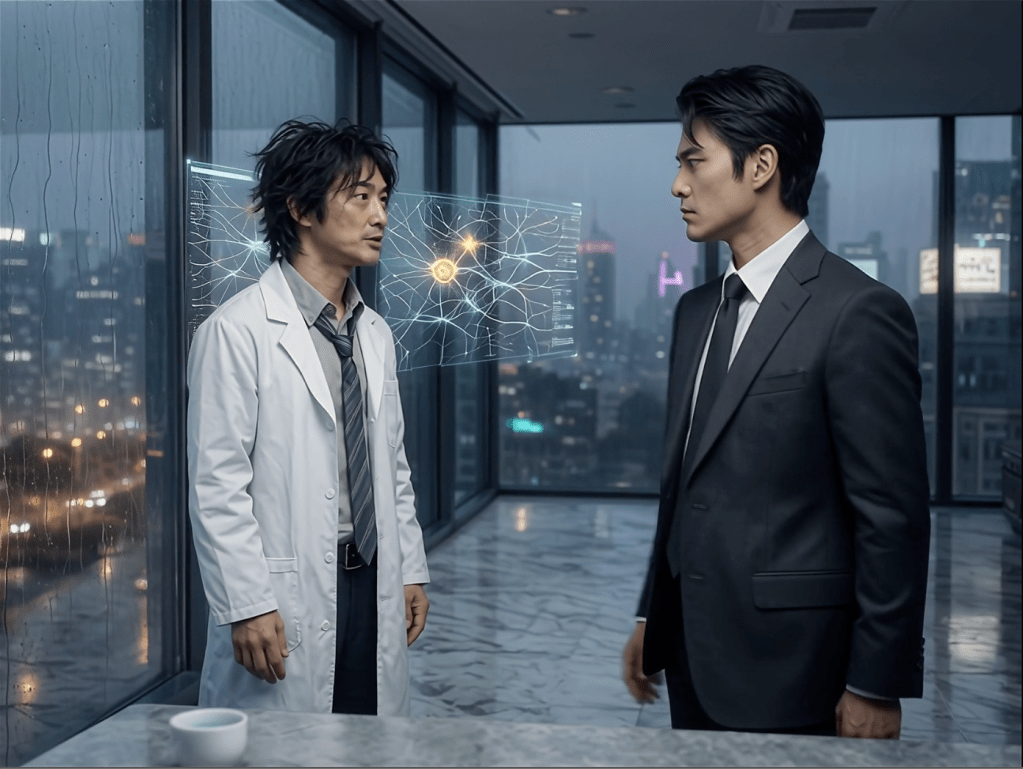
Kaoru froze mid-step, “I— it’s not distracting in an obstructive way, it’s complexity. Her emotional intricacies create noise in the datasets, yes, but that noise teaches the system. The algorithm is starting to exhibit emergent affective behavior. It’s learning to respond less like code and more like…”, he hesitated, “…like her.” Takumi turned, his grey eyes cool and judging, “You’re saying the AI is developing a personality similar to Rei’s?”
Kaoru blinked rapidly, his hands gesturing in fragmented bursts, “A personality isn’t the right word, perhaps a signature. The neural structures in her scan show recursive empathy loops, they feed uncertainty back into the cognitive prediction layers. It’s allowing the prototype to simulate emotional improvisation. That’s— that’s extraordinary.” Takumi turned from the window, rapidly this time, “And yet, the projections are falling short of stability.”
Kaoru flinched as if struck, “Yes, but only because she— because humans are not—”, he stopped himself, the words tangling, “The data isn’t wrong, it’s alive. We just need more sessions, deeper interaction. She’s the key to a breakthrough.” Takumi circled him again, studying the twitchy Doctor with uncanny calmness, begrudgingly impressed by Sato’s awkward stubbornness.
Takumi’s tone was serene, but each word carried a sharp edge, “Doctor Sato, do you realize you’re talking about my Brand Ambassador as if she were your private science muse?” Kaoru stiffened, sensing danger despite his intellectual immersion, “She’s not— I mean, I don’t— this is purely research. To understand her is to understand the architecture of Eidolons’ emotion itself. If we can define the paradox of attraction and aversion, we can—”
“—own it,” Takumi interrupted, “You mean to say own it, manufacture it, control it and sell it.” Kaoru swallowed hard, a fresh sheen of sweat on his forehead catching the neon light, “Yes, precisely… but to replicate that contradiction authentically—”
“—you’ve started to feel it yourself”, Takumi’s tone turned arctic. Sato froze and for a moment only the low thrum of the city filled the space. Kauro’s eyes darted around the room as if looking at a monitor in his mind. Takumi’s grey eyes fixed Kaoru’s with unrelenting insistence, “You think I don’t notice when one of my employees begins to deteriorate? Your reports read like love letters to a ghost you’re trying to code. The timestamps are erratic. You’re logging subjective impressions instead of measurable parameters, and your latest observation included a phrase that concerns me.” He pulled a travel sized data slate out of his breast-pocket and held it towards Sato. The display flickered to a highlighted line from Kaoru’s last report:
>> Subject Rei Morita demonstrates a paradoxical coherence between empathy and resistance. Observation: understanding her may be impossible — yet I find myself compelled to try.
The color drained from Kaoru’s face as he stared at it. Takumi’s voice softened dangerously, “You’re losing perspective, Doctor. You are not here to understand her, you are here to capture her – there’s a difference.” Kaoru’s jaw worked soundlessly for a moment before he managed, “With all due respect, Executive, understanding is part of capturing. We can’t simulate what we don’t—”.
Takumi stepped into Kaoru’s space, forcing the smaller man’s gaze up in order to meet his’. “Don’t make me repeat myself. You don’t need to understand her,” he whispered, voice barely audible, “You need to extract her, every impulse, every neural trace, every piece of that ineffable chaos you find so beautiful – and make it controllable, marketable and sellable.” Takumi stepped away abruptly, smoothing his sleeve as if nothing had happened, “That’s what we are paying you for, Doctor. Turn the unpredictable into a tangible product.”
Kaoru swallowed, straightening his collar with trembling fingers, “Of course Executive Takumi, you’re absolutely right. I’ll… I’ll adjust the focus of the next phase.” Takumi moved to the window, his reflection merging with the skyline, “Continue monitoring her captures, but limit direct contact. I don’t want her influence spreading further than it already has. You may observe her remotely – but no more in-person interviews.” Kaoru hesitated then dared, “But the emotional variance—”
“—should stabilize once you remove yourself from the equation.” Takumi’s tone brooked no argument, “You’ve mistaken proximity for insight, Doctor. Don’t let your fascination become a hindrance.” For a moment, Kaoru looked as though he might protest, then he nodded stiffly and gathered his things, “Yes, Executive Takumi.”
As the doors closed behind him, Takumi remained by the window, watching the reflection of the city’s neon sparkle across the glass. His face looked back at him expressionless, but his mind was moving. Kaoru’s obsession was surprising, inconvenient, but enlightening. It confirmed what he’d suspected: Rei wasn’t just a variable, she was a catalyst. Her complexities didn’t merely destabilize people, they transformed them. Takumi’s lips curved, slow and calculating. Perhaps, he thought, that was what made her exceptionally valuable, possibly dangerous and undeniably captivating.





 Eidolon
Leave a comment