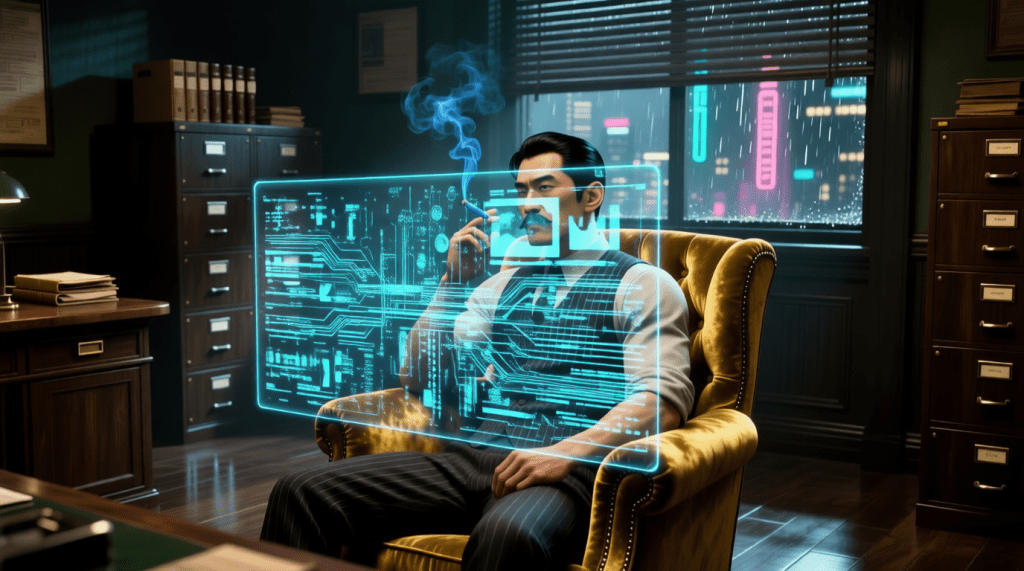
Karasu & a Helix Apex Mole
The back office of The Electric Dragon Den was lit only by the city. Second-hand neon from the street below burned through the blinds, pink and white veins pulsing against the dimness. The low hum of active holographic displays filled the room, steady, mechanical. Aoi stood by the desk, a mountain of muscle and quiet intent. His bald head caught the fractured light from the display as he swiped through the stolen data streams. Inked dragons and tigers curled over his forearms, flexing as he scrolled.
The screen reflected lines of Helix Apex code, fragments of biometric capture streams, strings of neural waveform data and biological chemical readings. Karasu sat behind the desk, sleeves rolled to the elbow, a cigarette burning down to its last third. His face was shaded, the faint glow from the monitor cutting across his features.
Aoi’s baritone voice broke the silence, “Got it off the Helix Apex data-vault thirty minutes ago. Took the mole two weeks to build a blind route that’d hold long enough to pull a full branch.”
He flicked a line of code upward, and the screen expanded into a simulation. Neural data points bloomed like constellations, “This is Helix Apex’s BICOCA core, Biometric Cognitive Capture Array. It’s the backbone of what they’re selling to Kuroda. It records everything about a person’s neural state as well as biological changes, via tiny needles and complex electric pulse patterns. Not just emotions or reactions – micro-cognitive processes, pre-linguistic thought patterns. They’re mapping identity itself.”
Karasu leaned forward, smoke curling between his fingers, “And Eidolon’s using it to teach their constructs how to feel real.” Aoi enlarged a set of data overlays, “Exactly. The BICOCA feed creates a complete imprint – like a memory fingerprint. Then Eidolon’s AI parses it, learning from the target’s linguistic habits, micro-expressions, response timings, emotions… hell, even their ticks, idiosyncrasies and insecurities. It’s what gives their virtual double that ‘alive’ effect.”
Aoi paused, neck muscles moving as he zoomed in on the code, “But it’s not perfect. It needs clean simple data. Organic, high-fidelity recordings of emotional triggers. If the source is noisy, trauma, stress, inconsistent context, then the imprint destabilizes, becomes… uncanny. That’s why they’re pushing the Helix recorders. The BICOCA tech, in theory, smooths out the edges, makes dirty emotions look polished.” Karasu’s fingers drummed on the table, the dangerous calm settling into him, “So Eidolons ambition is dependent on noise suppression?”
“Yeah. But here’s the thing,” Aoi said, dragging another file into view, “They’re not just collecting data to replicate people. They’re training Eidolon’s conversational AI on these imprints. Every construct gets seeded with baseline patterns from hundreds of captures. Then it learns to adapt, mix and match human mannerisms until it can pass as authentic. You can talk to it for ages and not realize it’s just spitting back a statistical echo of what it’s learned.”
While his cigarette burned out between his fingers, Karasu’s Master Spider’s instincts worked overtime. He let the bud drop into the ashtray, eyes on the cascade of data. “Which means the weakness in its AI,” he murmured, “can be exploited via feeding it complex seed material. Corrupt the inputs, you corrupt the constructs.”
Aoi barely grinned, a cruel twist of the lips, “That’s exactly what I was thinking. If we can introduce variance in the biometric baselines, emotional mismatches, timing errors, the constructs start to stutter. They break immersion.” Karasu stood, the tension in his frame loosening, “Our mole. What’s his status?” Aoi checked his slate, “Cover not blown. Works in data processing analysis. Middle-tier analytics at Helix Apex, but solid access to their R&D shadow logs.”
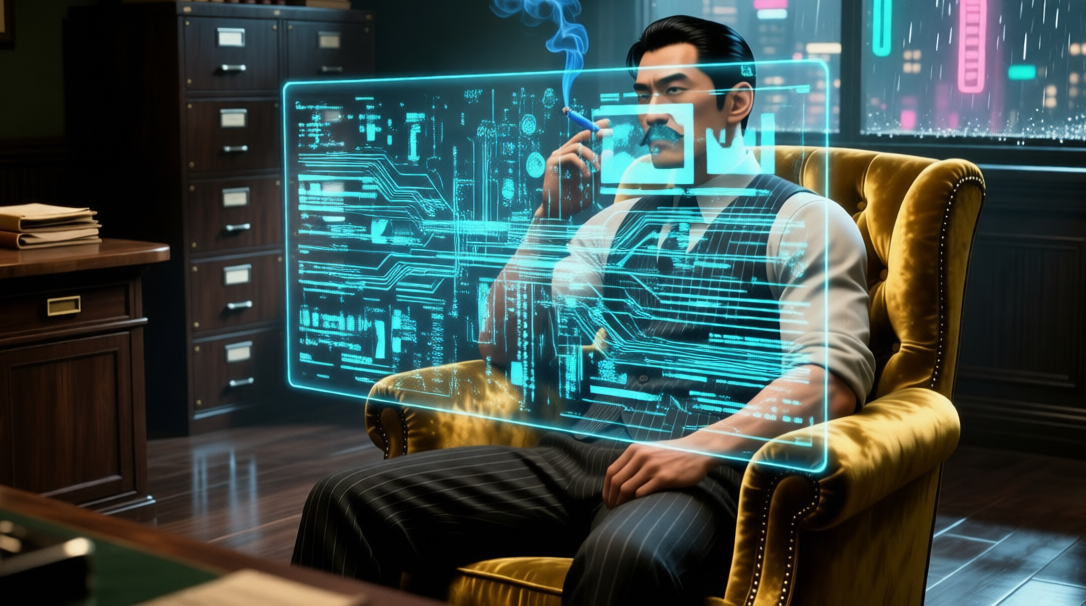
“Move him”, Karasu said flatly, “Get him embedded in the joint project with Eidolon’s pipeline. The integration layer, not the display front. I want him close to where they’re merging the BICOCA data with the simulation frameworks.” Aoi’s head inclined firmly, “Understood. You want him to feed garbage data?” Karasu’s gaze flicked to the code, then to the faint reflection himself, “Not garbage, imperfection, truth, paradoxes. The kind that looks useful enough to pass initial checks. Just… confusing enough to make the construct drift.”
The low light caught the faint glint in Karasu’s pale blue eyes, as they lifted to meet Aoi’s, “Make them build their new paradigm on phantoms that don’t behave.” A smile spread on Aoi’s face and he nodded once in understanding, “The mole’ll need improved cover. Helix is paranoid since Bjorn Jorgensen started the collaboration with Kuroda. They’ve tightened an already strict security,” Karasu lit a new cigarette, “Give him a support Spider, a larger retainer and tell him”, he took a long drag before continuing, “to be patient, invisible and when the moment comes – to pull the thread.”
Aoi stepped closer, folding his massive arms, the ink shifting. “Nephila,” he said after a beat, “Are you’re worried about Rei?” Karasu didn’t answer right away. The smoke drifted between them, a soft veil hiding the flicker of something behind his eyes.
“She’s inside the system they’re building,” he said after a few drags, voice quiet but iron-edged, “If Eidolon perfects its tech, they won’t just imitate her. They’ll clone and own her… down to the thought.” He exhaled, a thin stream of smoke rising like a prayer and a curse, “So we’ll hit them where it hurts most – their budding development. Let’s see how real their dreams feel when they start to feed customers nightmares.”
The two men stood in silence for a moment. Chochin flickering outside, the bleeding neon mixing with the faint digital shimmer of stolen secrets illuminating their faces. Then Karasu turned toward the holographs, eyes on the BICOCA streams, “Start tonight, Aoi. Instruct the mole…”, he paused, voice lowering, “If he sees the construct version of her, or the real her, to record everything and report it immediately.”
The mole
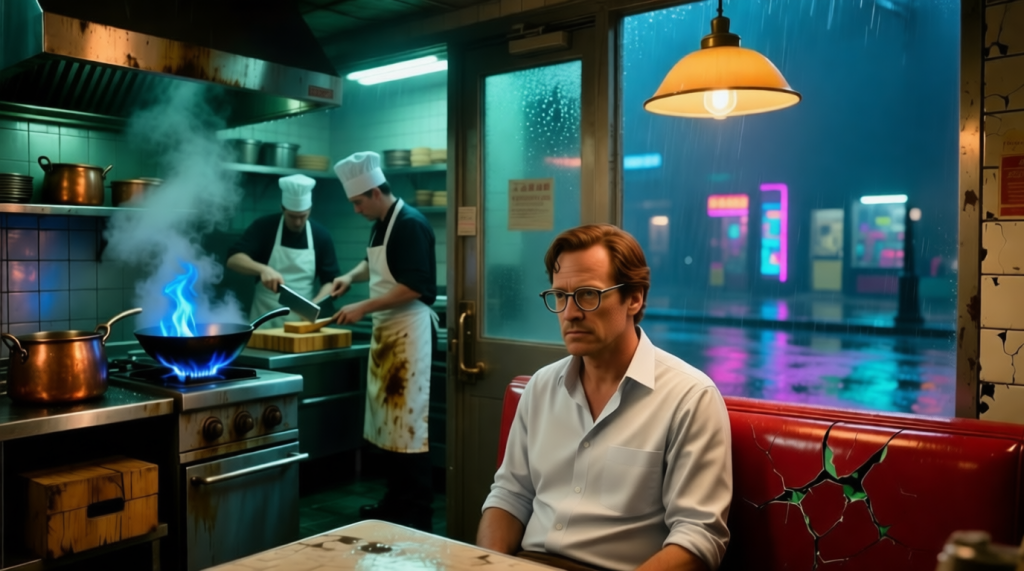
His name was Leo Mercer, and he felt utterly at home in the controlled chaos of a Chinese restaurant kitchen. The Jade Dragon was tucked in a half-basement off one of Mirage City’s less-glitzy commercial arteries. It was loud, steamy, and gloriously analog. Woks roared with blue-tipped flames, cleavers thudded rhythmically on worn wooden blocks, and waiters shouted orders in a rapid-fire blend of Cantonese and city-slang. For Leo, it was the perfect antidote to the silent, sterile pressure of Helix Apex’s data labs.
He slid into his usual booth in the back, the red vinyl seat squeaking under him. At thirty-four, Leo looked like what he was: a man who’d been brilliant once and was now just very, very good. He had the kind of unremarkable, pleasant face that blended into a crowd, brown hair already thinning, a build that spoke of too many hours at a desk and not enough at a gym. His eyes, a faded hazel behind wire-rimmed glasses, held a permanent, weary intelligence. They were the eyes of a man who saw patterns in everything, especially in the ways life had cheated him.
A decade ago, at Stanford, he’d been the star. His thesis on neural-pattern forecasting in affective computing was groundbreaking. He’d called it The Emotional Rosetta Stone. His professor had called it a guaranteed fortune. Then his lab partner, a sleek, silver-tongued sociopath named Chase, had presented the core algorithm at a private investor meeting a week before Leo could file the provisional patent. Chase had charm and connections, Leo had integrity, and the naive belief that the work would speak for itself. It didn’t. Chase’s startup was now a mid-sized player in the simulacra market. Leo was Senior Data Analyst #7 at Helix Apex.
The bitterness wasn’t a sharp knife anymore; it was a dull, constant ache, a low-grade fever of resentment. It was why, after too many sleepless nights in dive bars, listening to stories from people whose lives were tangles of corporate malice, he’d let himself be approached by a calm, mountainous man named Aoi. The offer wasn’t just money, it was purpose. A chance to subtly, expertly, make the ‘cutthroat types’ bleed from a thousand tiny, untraceable cuts.
His mapo tofu arrived, a volcanic landscape of chili oil and minced pork. As he broke apart his wooden chopsticks, he felt the subtle, specific vibration from his burner phone, nestled in the inner pocket of his practical, corporate-branded puffer jacket. Not a call, but a data-pulse, Aoi’s signature.
Leo ate a bite, the numbing heat of Sichuan peppercorns blooming on his tongue, then casually pulled the phone out as if checking a message. To any observer, he was just another overworked tech guy ignoring his dinner. The screen displayed a seemingly innocent promotional email from a Norwegian hiking gear company, subject line: Your Fjord Trail Itinerary Confirmation!
He opened it. The body text was bland, filled with details about waterproof ratings and cabin rentals. The lamp above his table highlighted an anomaly, a corruption in the embedded logo. Using the edge of his chopstick, he tapped a specific, seemingly random sequence on the image and the decryption layer unfolded. The instructions revealed themselves seemingly as part of the email, but only visible under his lamp from his specific angle.
<Priority Shift.> <Your access is being elevated to Joint Project Pipeline (JPP), Integration Layer, Eidolon-Kuroda synthesis stream. Target: BICOCA data fusion nodes.>
Leo’s pulse ticked up, but his expression didn’t change. He took another mouthful of tofu, the spice masking the dry click in his throat. The integration layer. That was the heart of it. Where the raw, screaming truth of human biometrics was sanded down and slotted into the AI’s waiting frameworks. The message continued.
<Objective: Introduce permissible variance.> <Seed baseline datasets with emotional paradox. Conflicting micro-expressions within a single emotional valence. Joy patterns undercut by subconscious fear spikes. Affection data threaded with latent aggression signatures. Priority target: any construct designated for high-fidelity social replication.>
A faint, cold smile touched Leo’s lips. It was beautiful. They weren’t asking him to crash systems or plant viruses. They were asking him to poison the well with reality itself. The AI was an obedient student, born to learn. He would teach it that humans were contradictions; that a smile could hide a snarl, that a caress could telegraph a threat. The constructs would learn to stutter, to feel uncanny, because they’d be too real in the wrong ways.
<Cover fortified. Retainer increased. Support asset on standby. Pattern: patience, invisibility, precision. Await signal for thread-pull.>
Then, the final line, which made the spicy food burn longer in his mouth:
<Eyes open for primary biometric source: Female, designation ‘Rei’. Capture all incidental data on her or any simulacra derived from her profile. Immediate report.>
Rei. He’d seen the summaries. The flagship subject for the latest BICOCA jewelry suite. The data was astonishing. Unnervingly potent for someone who, according to gossip, lived in a pressure cooker of corporate politics. Kuroda was building something with her imprint. Leo closed the email. The encrypted data would shred itself in sixty seconds. He set the phone down and stared into his bowl of fiery, chaotic goodness.
This was the revenge he’d craved, not against one thief, but against the entire, soul-eating system that bred them. He wouldn’t just be Senior Analyst #7 anymore. In the shadows, he’d be the saboteur, carefully misaligning the stones so the whole spire would someday lean, then crack, then fall.
He finished his meal, paid in cash, and stepped back out into Mirage City’s humid, neon-drenched night. The glow from the Kuroda Plaza towers in the distance seemed less like symbols of power and more like targets. Leo Mercer adjusted his glasses, shoved his hands in his pockets, and walked toward the monorail station, a ghost with a new mission, already planning his first, perfect, imperfection.





 Eidolon
Leave a comment