A new home
The weeks bled together in a rhythm of neon, sweat and smoke. Rei’s world shrank to three spaces: Karasu’s apartment, The Electric Dragon Den, and the backroom dojo where Aoi’s son Aoto taught her the art of fists and footwork.
By day, she shadowed the hostesses in their back room; not yet allowed out on the floor. They showed her how to hold a glass so the light caught her wrist just so, how to smile without warmth but with promise, how to slip a question between a laugh and a touch so that men spoke without realizing they had given anything away. At first, Rei stumbled; her laughter too sharp, her hands too stiff. But she learned quickly. Within a week her voice could soften, her posture could shift from predator to porcelain doll. She became slowly but surely more fluent in the language of masks.
By night, sweat slicked her skin as Aoto drilled her in the basics: stance, balance, how to read a strike before it landed. He was built like his father Aoi; towering, compact, sharp-eyed, movements clean as steel. At first he treated her like glass, insisting on no sparring matches. But Rei pushed harder, demanded more. He gave in partially, sparing but holding back immensely. Still, small bruises bloomed along her arms, her ribs, her knuckles. She wore them like jewelry.
Food changed her. Karasu kept her fed properly; meat, rice, broth instead of scraps and instant noodles. Sleeping in a real bed softened the severe lines of her body. Muscle and fat stretched over her frame where once there was only bone. Her jacket still hung patched and rough, but now her presence filled it. Karasu got her some new clothes, slightly too big, something for her to grow into. The hostesses noticed Rei blossoming, complimenting her and teaching her positions to draw attention to her growing breasts, hips and thighs. The men at the club noticed too. Aoto noticed most of all; his eyes lingering, just a second too long during practice in the dojo, before snapping away with an almost blush of someone still learning discipline.
Karasu tracked her appetite, her reflexes, drilled her in conversation during meals; noting the ways her voice shifted when she repeated his lessons back at him. Sometimes he tested her. At breakfast, he would ask her to make him talk about something he didn’t want to discuss. Though she always failed, she improved. At dinner, he would lean back, arms crossed and wait for her to steer the conversation. Rei adapted quickly. She was learning when silence pulled words from a man’s throat and when to strike with a question that cut deeper than a knife.
Food
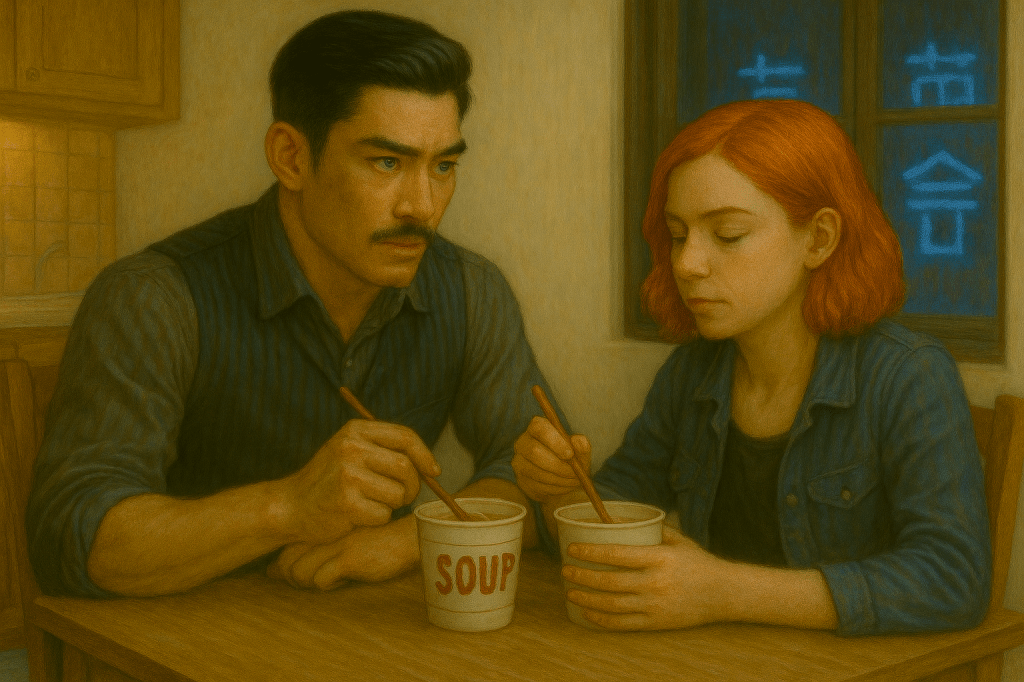
The first weeks, Karasu almost forgot about asking Rei to cook, but as soon as she looked less frail and strong enough for more responsibility, he decided to make her his personal chef. One morning a chip of Fund Units landed on the small wooden table with a dull clink. Rei looked up from the simple instant miso soup she was eating for breakfast, her eyes shifting from the glowing money piece to Karasu, who sat down at the table, not touching the plastic cup-soup standing ready in front of him.
“Making us real food is your responsibility from now on,” he said, his voice flat, “Breakfast and dinner. Lunch is always takeaway during work hours. Don’t waste it.” He looked down at his steaming soup, but instead got up to leave, then paused, a sliver of memory surfacing in his sky-blue eyes, “Your mother… she had a way with ingredients. I won’t assume it was hereditary… but do your best,’” His gaze flickered over her, taking in the lingering thinness in her wrists, the sharpness of her collarbones. Then he was gone, leaving Rei staring at the small fortune on the table. For a moment, it felt like just another transaction. But as she closed her fingers around the cool, smooth Fund Unit chip, a different feeling bloomed in her chest; not just obligation, but a flicker of excitement.
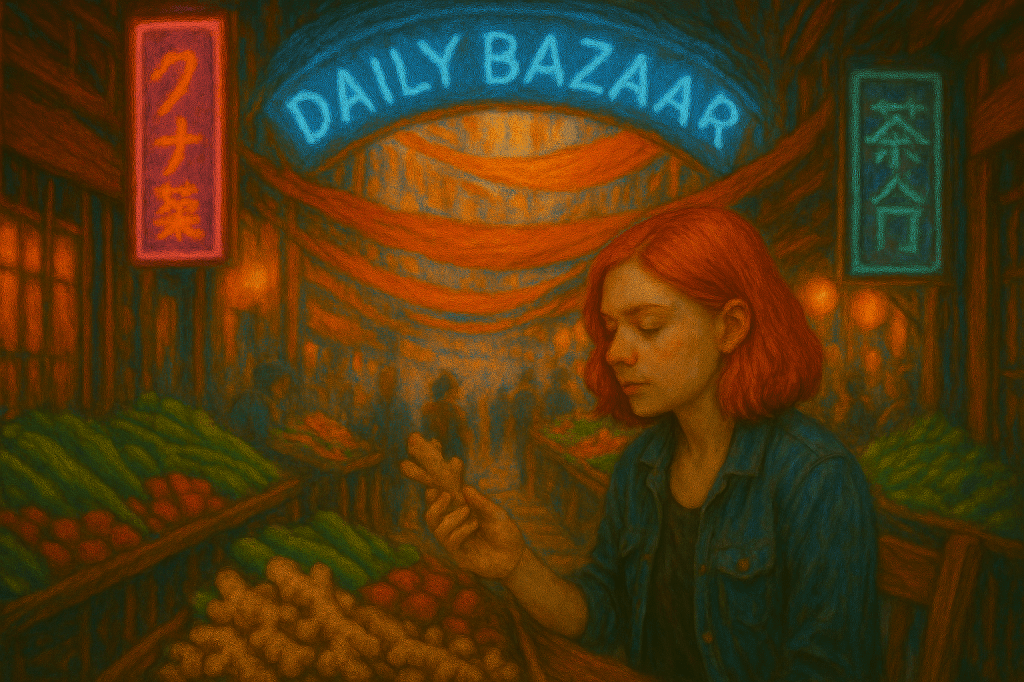
An hour later, she stepped out of the Den’s heavy lacquered door and into the vibrant chaos of Chochin Row. The air, thick with the smells of sizzling street food and ozone, was usually a reminder of survival. Today, it was a symphony of possibilities. She ignored the glowing signs of the Synapse Dive parlors and headed straight for the daily bazaar that spilled through a side street, a riot of color and noise under patched awnings.
This was her element. Her mother’s voice echoed in her head as she moved between the stalls: “See, Rei? Not with your eyes, with your nose. Smell the ginger – it should be sharp, not soft. The fish should smell like the ocean, not the dock.” Her thin frame wove through the crowd with a new purpose. Her eyes, usually so guarded, lit up as she inspected bundles of fresh shiso leaf, their fragrance clean and peppery. She ran a thumb over the firm, glossy skin of an eggplant, selected a piece of ginger with taut, unwrinkled skin. She haggled with a wizened old woman over a handful of enoki mushrooms, a brief, sharp exchange that ended with a smile from both of them. This wasn’t just shopping; it was a connection to a part of herself she thought she’d lost.
That evening, the small, sterile room at the top of the Den was transformed. The scent of garlic sizzling in good oil, of fresh basil and ripe tomatoes, cut through the ever-present smell of incense and smoke that seeped up from below. Rei, using the stove, moved with a grace she’d learned at her mother’s side. She prepared a simple pasta aglio e olio, the way her mother had taught her, the way that tasted of a small, warm kitchen and laughter.
When she placed the bowl in front of Karasu at the table later that evening, he eyed it with detached curiosity. He took a bite, chewed slowly, and then his eyebrows lifted almost imperceptibly. He said nothing, but he finished the entire bowl, a silent testament that spoke volumes. The next night, she cooked Italian again. But as she ate, she felt a pang. The flavors were perfect, a loving tribute, but they were also a ghost. They reminded her of a happiness that was gone.
The following morning, she went back to the bazaar. This time, she bypassed the tomatoes. She sought out the finest dashi kombu she could find, selected katsuobushi shavings that curled like woodsmith’s planes, bought the freshest tofu and a handful of delicate green onions. That night, the air was filled with the clean, profound scent of a truly excellent dashi broth.
She served Karasu a bowl of miso soup, but this was unlike any he’d ever had from a takeaway container. The broth was deep and complex, the tofu silken, the wakame tender. He took a spoonful, paused, and then looked at her, a genuine, unguarded surprise on his face. “This is different,” he said, his voice low. “I prefer Japanese food,” Rei said simply, not meeting his eyes as she blew on her own bowl. Karasu gave a slow nod, “It’s exceptional.”
From then on, the evening meal became a ritual shared in silence. Karasu never offered effusive praise, but the empty bowl was his compliment. Rei, for her part, found a strange peace in the routine. In the careful selection of ingredients, in the alchemy of transforming them into something nourishing and beautiful. During dinners she wasn’t a spy-in-training or a piece on a board. She was her mother’s daughter. And in the simple act of feeding herself and the ruthless man who owned her, she was, for a few precious moments each day, free. It was the one debt she didn’t mind paying.
Aoi & Karasu
The scent of ginger and soy still hung in the air of Karasu’s apartment, a comfortable reminder of the dinner Rei had prepared. She was at the sink, her back to the room, the water running as she scrubbed a lacquered bowl. The soft click of the door announced Aoi’s arrival.
“Evening Aoi,” Karasu’s voice came from the sofa area. He was lounging, a cigarette already smoldering between his fingers, “We’ll debrief. I have a new sake you need to try. A rare vintage from the highland springs.” He stood, stubbing out the cigarette, “It’s in the bedroom. I’ll find it.” As Karasu disappeared into his room, Aoi moved with his usual, silent force. But he didn’t immediately sit. He paused, his massive form a dark silhouette against the city-lit windows, and watched Rei.
The weeks of consistent meals had worked their magic. The sharp, worrisome angles of her frame had softened. There was a new roundness to her shoulders, a healthy glow to her skin that the neon lights couldn’t mimic. She was humming softly, lost in the task, a picture of focused domesticity. Aoi’s expression was unreadable. With a motion so fluid it seemed incidental, he raised his personal comm-unit, pretending to check a message. The camera lens focused on Rei’s profile for a silent second before he lowered the device.
“Are you settling in alright?” His voice, a low rumble, cut through the quiet. Rei jumped, the bowl clattering in the sink. She turned, water dripping from her hands, her eyes wide with surprise. She quickly bowed her head, “Yes, Aoi-san. Thank you. I am.” She picket up the bowl, rinsing it again. “My son, Aoto,” Aoi continued, his tone neutral, “He tells me you are a fast learner.” At the mention of Aoto, Rei’s guarded expression melted. A genuine, uncalculated smile touched her lips, and she looked up, meeting his eyes, “He’s a good teacher! But he’s going so slowly. All I do is punch and avoid a swinging bag. I feel like I’m not learning self-defense, just to… interact with an inanimate object.” The words came out in a rushed, honest blurt.
Then, as if suddenly remembering who she was speaking to, the second-most dangerous man in the Den, a mountain of silent power, her smile vanished. She looked down at the floor, her voice softening, “Not that I’m complaining. Aoto is a great teacher. I’m just… impatient.” Aoi’s lips curved into an almost indiscernible smile, “Knowing how to avoid and punch a bag is the foundation for anything else. Patience in a fight is not a virtue. It is a necessity. An unwise, hurried reaction… a missed or failed crucial blow… that can be a death sentence in Mirage City.” Rei absorbed this, her head still slightly bowed, “I understand. Thank you, Aoi-san.”
At that moment, Karasu emerged from the bedroom, holding a beautifully glazed bottle. His sharp eyes scanned the room, taking in Rei at the sink and Aoi standing near the sofa. His gaze lingered on Rei, and a flicker of displeasure tightened the skin around his mouth. He had not given them permission to interact or for her to pause in clearing the table. Rei gave a quick, formal bow and turned back to the sink, her movements now hurried.
“Change of plan,” Karasu said, his voice cool, “We’ll take this to the office. The atmosphere is better for business.” Aoi simply nodded, already turning toward the door without a word of protest. As they left, Karasu paused in the doorway, casting a look back at Rei, who had frozen at the sink. “Finish cleaning. Then go to bed early,” he instructed, his tone leaving no room for discussion, “Read the book I gave you on physical tells first. Cover the first three chapters.” Rei kept her eyes downcast, her posture compliant, “Yes, Karasu-sama.”
The door clicked shut, leaving her alone in the suddenly silent apartment. The brief, almost-normal moment with Aoi had passed, and the reality of her life, of lessons, obligations, and the ever-watchful eyes of powerful men, settled back over her like a heavy cloak.
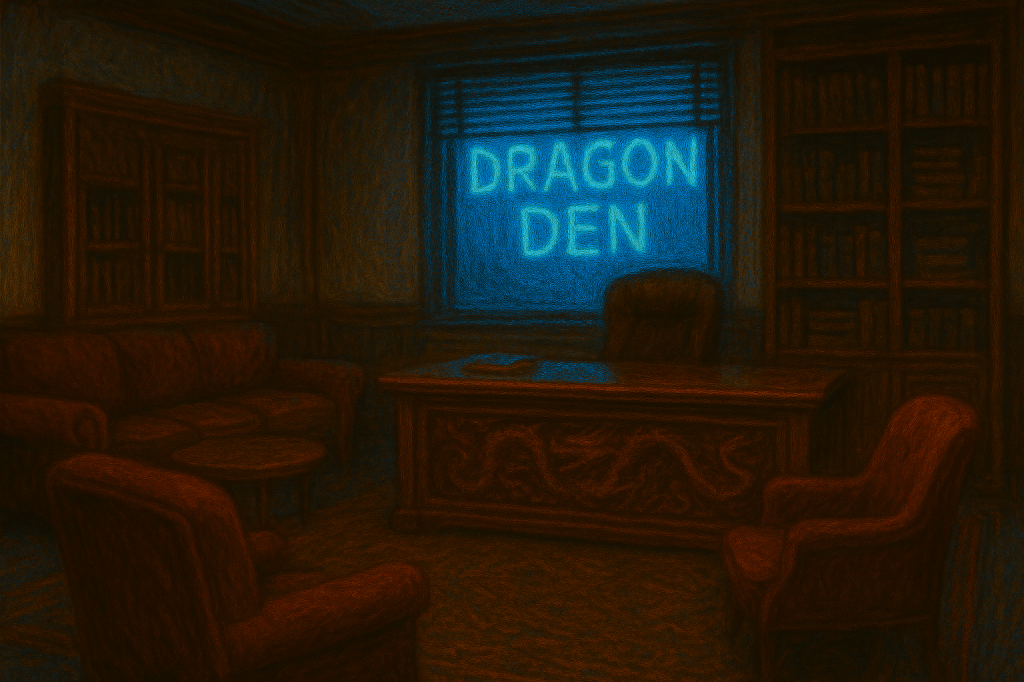
The back office at the Den was the picture of measured power. It wasn’t as decadently opulent as the main floor, but it was far grander than Karasu’s spartan apartment. A high-quality wool carpet silenced their footsteps. Upon entering a sitting area with low velvet couches rested. To the right, dark wood cabinets housed ledgers and data-slates. The far wall was dominated by a lacquered desk, intricately carved with coiling dragons, behind which stood an elegant high-backed leather chair. The windows behind it were partially shuttered, but the relentless, rhythmic pulse of the Den’s electric blue neon sign bled through, staining the room in waves of cold light. A single velvet armchair, sat before the desk for supplicants.
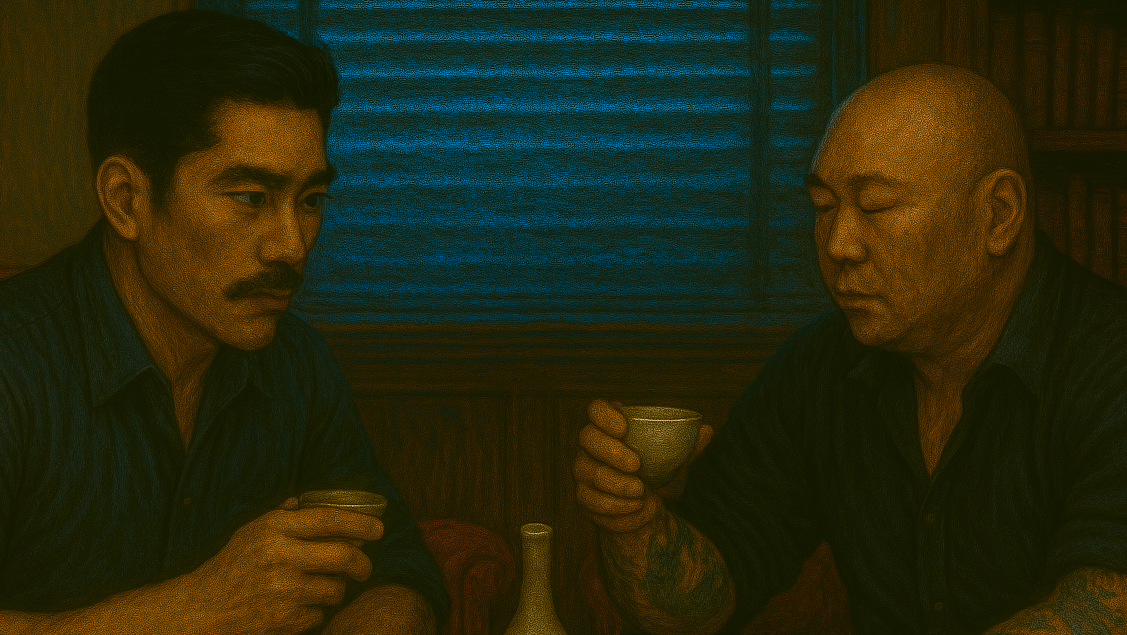
Karasu moved to a mirrored bar in the corner, his movements tight as he grabbed two delicate ceramic cups. He poured the sake with a tense precision that betrayed his simmering annoyance, the liquid catching the neon’s glow. Aoi settled onto the plush velvet sofa in the sitting area, his immense frame making no sound. He didn’t speak, simply waiting, his presence a calm counterpoint to Karasu’s brewing storm. Karasu brought the cups over, handed one to Aoi, and took a long sip from his own. He closed his eyes for a moment, “It is good. Clean. Like ice over a lake.” He opened his eyes, the blue within them sharp as shards, “What did you talk to her about?” The question was casual, but the undercurrent was unmistakable: the jealousy of a controlling owner, thinly veiled.
Aoi took a slow, appreciative sip of his own sake, letting the silence stretch for a beat before answering, “Small talk. I promised her dad to send a few photos of her. On a one-way comm. So he can see she is alright.” Karasu’s jaw tightened. He could tell Aoi was telling the truth, but the answer displeased him further, “Why bother with that wreck? He sold his own kid.” Aoi shrugged his massive shoulders, the motion fluid and calm, “I am a father myself. It was an easy thing for me to do. For him, it will mean everything.” He took another sip, his dark eyes steady on Karasu over the rim of the cup. He paused, then asked the hazardous question, his voice deceptively mild, “Why are you getting so worked up over this girl? … and you’ve never taken people as payment before”, he let the implication hang in the smoke-scented air before adding, “Are you taking a liking to her?”
Karasu let out a short, bitter laugh, his face a mask of appalled exasperation. But he didn’t answer. He drained his cup and reached for the bottle to pour another, the liquid sloshing slightly. He stared into the pale gold sake, thinking. “I don’t know,” he finally admitted, the words quiet, almost lost under the hum of the jazz pulsing below them, “She seems different. A potentially great investment – or a truly terrible one.” He shrugged, a gesture of overwrought nonchalance, “If things turn sour, I can always get rid of her.”
Aoi listened, his expression giving nothing away. He began to reach for the data-slate on the low table between them, a clear signal to move to business. But Karasu wasn’t finished. He lit a cigarette, the smoke rotating like concern, “The hostesses, the employees… they come to me already fine-tuned to their goals. Their scars are healed, even if they’re sore and troubled”, he gestured vaguely with the cigarette, “Rei… it’s like she’s still bleeding from all the crap this city put her through. If I can shape that healing… I could teach her. Make her into something truly great. Something the others could never be.” Aoi nodded slowly and lowered the data-slate he had just picked up. He chose his next words with the utmost care, his tone deeply respectful, ensuring Karasu knew his place was not being challenged. “With all due respect, Komorebi-sama,” he began, “a girl like that… sharp-tongued, with a fire in her eyes, growing more beautiful by the day… she might also teach you something“, Aoi met Karasu’s glare coolly, “She might either mess up the scars you have… or help heal them”, he let the weight of the statement settle, “I just mean… surely you already know this… but a girl like that, living in your flat? It’s a risky variable.”
Karasu’s head snapped up, the warning shine in his eyes could freeze hell over. It was a look that silenced executives and broke fighters. Aoi immediately put his hands up in a gesture of surrender, the glowing screen of the data-slate in one hand faced outward as if presenting the agenda. Karasu took a long, controlled drag, visibly reining in his temper. The neon light flashed across his face furiously. “That’s enough about Rei,” he said, his voice returning to its usual, clipped authority, “Give me the report. Let’s get this settled quickly.”
Primer on Physical Tells
Rei’s small room was quiet, a stark contrast to the perpetual thrum of the club below. Rei was curled in her narrow bed, the blanket pulled up to her chin. The only light came from a small reading lamp, casting a warm pool over the open page of the book Karasu had given her: The Unspoken Language: A Primer on Physical Tells. She read the first line, the words feeling like a key turning in a lock she hadn’t known was there.
“Physical tells are unconscious behaviors that reveal a person’s emotional state or intentions. They are the body’s betrayal of the mind’s secrets.”

Her mind instantly flashed to the hostess floor. The first time she watched the top hostess Yuri work, her client had wandering hands. His increased fidgeting, his fingers constantly drumming on the table, tapping his glass. She’d thought he was just impatient. Now she saw it for what it was: a sign of nervousness or uncertainty. He hadn’t been confident; he’d been trying to project a confidence he didn’t feel. She read on.
“Eye Contact: Longer, more frequent eye contact can indicate confidence, while avoiding it may signal discomfort.”
Rei thought of the young guy at the daily bazaar, selling carrots and onions, his eyes so earnest, holding hers until the moment he handed her the bag of vegetables. That had felt like confidence. But then she remembered him as her hand had grazed his during the exchange of the bag, his eyes darting away at the touch, the blush creeping up his neck. Discomfort. Insecurity. The book was teaching her to dissect moments she had only felt intuitively.
“The way a person handles objects can be a tell. A soft, quiet movement might indicate a weakness, while a strong, forceful motion could signal strength.”
Rei remembered Aoi placing his hand on her father’s trembling shoulder. The giant’s movement had been soft, almost gentle. Was that weakness? No. It was absolute control. The strength was in the restraint. Conversely, she thought of her father, Jin, fumbling with his collar, his hands shaking as he reached for her. Forceful, but without control. A tell of sheer, unadulterated panic. Another crucial passage caught her eye.
“Weak Means Strong, Strong Means Weak: Some tells are intentional misdirection. A person might act weak to invite certain reactions, or appear very confident to scare opponents away when they are bluffing.”
This was the most dangerous lesson. It made every interaction a potential lie. The client who feigned helplessness to lure a hostess closer. The corporate exec at the bar who boasted loudly about a deal, his voice booming with false confidence – was he securing a victory or trying to spook a competitor?
“Focus on the hands. In conversations where someone is concealing information, the hands can be a source of reliable truth.”
Rei looked down at her own hands, resting on the page. She thought of Karasu’s hands, constantly rolling a blue cigarette, tapping ash, a steady, rhythmic tell that spoke of a mind constantly calculating, never at rest.
“Body Language: A relaxed, open posture suggests confidence. A rigid or leaning-forward stance indicates tension.”
An image of the wizened old woman at the other end of the daily bazaar came to mind. When Rei first approached, the woman had been slouched, relaxed. But the moment Rei pointed at the mushrooms and daikon and named her price, the woman’s spine straightened, her shoulders went back, and she leaned forward, her chin jutting out. A rigid, leaning-forward stance. Tension. She was preparing to defend her price. She had the upper hand and knew it.
Then, a more chilling memory: Karasu. He was almost always in a state of relaxed, open posture, draped over his booth like a king. But the few times a real threat had entered the Den, a rival fixer, an over-augmented brute, Karasu didn’t tense up. He went perfectly, dangerously still. It wasn’t the tension the book described. It was something more controlled, a predator conserving energy. Context is key, the book warned. Establish a baseline. Karasu’s baseline was a deceptive calm. She turned the page, her fingers tracing the text.
The neon from the street below bled around the edges of Rei’s window shade, painting a faint, pulsating stripe across the ceiling. The book lay closed on her chest, but its concepts churned in her mind, looking for a place to land. The examples from the hostess floor and the market were one thing. They were simple equations. But the most complex, dangerous cipher in her world was Karasu Komorebi himself. To understand the lesson, she had to apply it to him.
What was Karasu’s baseline? It wasn’t the forced charm of a hostess or the nervous energy of a client. His normal state was a calculated, predatory stillness. He was often draped in his booth, one arm slung over the back, a cigarette smoldering between his fingers. His breathing was always even, his sky-blue eyes perpetually half-lidded, observing. That was his neutral setting. Any deviation from that was a data point.
She thought of the night he’d given her the book. His posture had been the same. But his hands… that was a deviation. He hadn’t just handed it to her. He had taken her hand, his touch deliberate, and slipped it onto her grip himself. The gesture was slow, almost possessive. At the time, she’d felt only the weight of the obligation. Now, she saw it as a cluster of tells. The deliberate touch (a break from his usual non-contact), the sustained eye contact, the slight lowering of his voice. It was a sequence: a physical connection, a visual lock, a verbal command. The message wasn’t just “here is a tool.” It was “you are mine to take care of.”
But then, contrast that with his behavior during their dinner debriefs. When he was critiquing her, his baseline held. He was the teacher, the owner. But when the conversation had, just once, strayed towards something personal, a fleeting mention of her mother, he’d broken his own rhythm. He’d taken a sudden, sharp drag of his cigarette, his eyes flicking away to the window. A single tell? Perhaps. But it was a deviation from the unshakable Komorebi baseline. It suggested a vulnerability, a scar she hadn’t known was there.
“Observe Beyond One Tell: Look for clusters of tells or a sequence of behaviors.”
This was the real art. A single fidget could mean anything. A cluster was a confession.
She recalled the moment in his apartment after Aoi had spoken to her. Karasu emerging from the bedroom, seeing them interacting. His baseline had shattered. His posture had gone rigid. The easy lounge was gone, replaced by a coiled tension. His voice, when he suggested moving to the office, had been a degree cooler, the words clipped. And his eyes… they hadn’t just glanced at her; they had pinned her to the spot with a silent, icy warning. That was a powerful cluster: rigid posture + changed vocal tone + intense eye contact. The emotion was unmistakable: controlled fury. But fury at what? At the interruption of his control? Or something more?
This led to the most critical, and frustrating, realization from the book: “Tells are often person-specific and vary in reliability.”
She could memorize every common tell in the book, but Karasu was his own lexicon. His anger didn’t look like a drunk guest’s anger. His interest didn’t look like the young guy at the bazaar’s interest. What did his jealousy look like? Did he even feel something as human as jealousy? Or was it purely the irritation of a master seeing his chess pieces move on their own?
To read him, she couldn’t just observe. She had to know him. She had to learn the specific meaning behind the slight tightening of his jaw, the specific intent behind the way he would sometimes roll the unlit cigarette between his thumb and forefinger before lighting it. Was that a sign of deep thought? Or impatience? She didn’t know yet. That would take time.
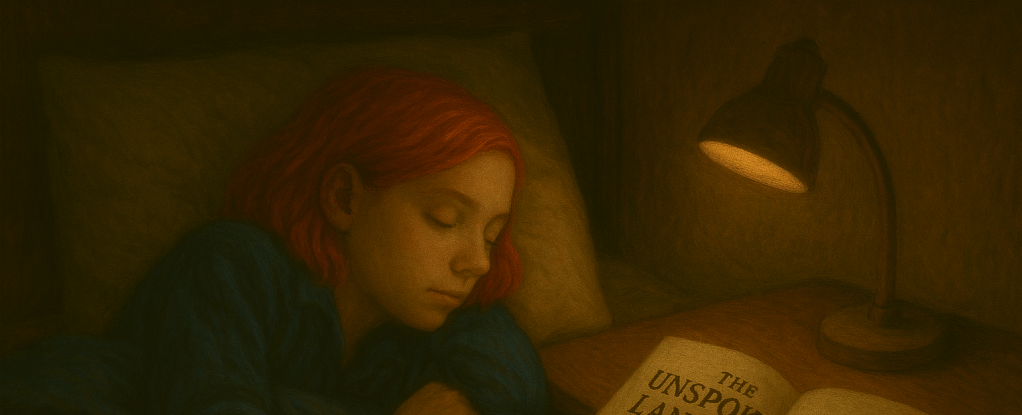
Lying in bed, Rei understood that this was the true assignment. The book was the theory, but the Den was the living text. Every dinner, every glance, every casual command was a sentence to be parsed. Karasu was teaching her to read people by making himself the primary impossible subject. And the most dangerous part was the dawning awareness that to become skilled at this, to truly learn to weaponize this knowledge, she would have to study him with an intimacy that went far beyond that of a student and her teacher. She would have to learn the landscape of his tells, what made his anger flare, not only to avoid them, but to understand how they shaped every move he made. The thought was terrifying. And, a secret part of her whispered, that it was thrilling too.
Closing the book, Rei switched off the lamp. The room was plunged into darkness, but her mind was alight. The Den, the market, every person she passed on the street; they were all suddenly speaking a second, silent language. She had been consciously illiterate, relying only on her intuition and the loudest, most obvious signs. Now, Karasu had given her a dictionary. Lying in the dark, she realized she was no longer just living in the world of unscrupulous people. She was beginning to learn how to read them.




 Eidolon
Leave a comment